Picture Yourself Rotating THESE in Space
Remember those images of shapes broken up into little square boxes, and the multiple choice test asking you to picture the same shape rotated differently? 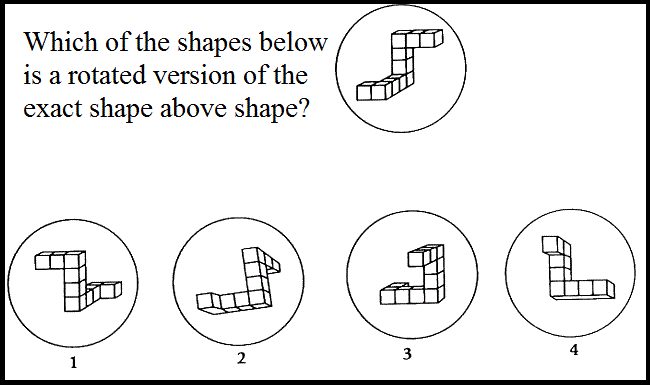 Such spatial reasoning is a stereotypically male skill. Well, a study out of the University of Berlin shows that women who were asked to imagine themselves having stereotypically masculine personality traits–strength, risk taking, assertiveness, and the like–performed as well as male peers on the spacial reasoning test immediately following this picture-yourself-as exercise, while women who were asked to imagine themselves having stereotypically feminine personality traits–agreeableness, caring for others, etc.–performed much lower than male peers on the special reasoning test right afterward.
“Gender priming” influenced women’s performance, big time.
This reminds us that allowing women to imagine themselves with the assertiveness and entitlement to fight back against an assailant can make an appreciable difference in their actual ability. If you can picture testicles rotated in space, you might be more likely to be able to actually rotate them in space if a guy you’re with won’t take no for an answer.
Top Ten New Signs to Hang on College Frat Houses on Move-In Day
There has been significant media coverage of the signs that a fraternity at Old Dominion and an all-male house of Ohio State students hung out their house windows this week to “welcome” the first-year women to their campuses. Signs like, “ROWDY AND FUN. HOPE YOUR BABY GIRL IS READY FOR A GOOD TIME!” and “DAUGHTER DAYCARE.” And posters for sale in the Student Union at Appalachian State this fall included this gem:

Good for these guys! We applaud their truth in advertising, letting the incoming women, their families, and the college communities at large know that they are predatory groups of men looking to score with wiling women, or maybe even coerce or assault women who aren’t willing. It’s an important step in acknowledging the violence and misogyny that too often accompanies life in all-male social clubs.

 5. WELCOME TO THE HOUSE OF EXTRAVAGANT FREEDOM AND SCANT RESPONSIBILITY!
DR. SEUSS’S SELF-DEFENSE STORY
Not in a box, with a fox, not on a train, but on a blog with Jane…
Everyone is excited about the recently discovered orphaned Dr. Seuss story. Dr. Seuss was an awesome, politically progressive storyteller. For example, Horton Hears a Who and The Lorax deal with environmental protection; The Grinch Who Stole Christmas is a critique of consumerism; The Sneetches is about the rich using cosmetic surgery to distinguish themselves and the technologists who profit from their efforts; and The Butter Battle Book is about prejudice and discrimination.
Ranking in the top 10 best selling Dr. Seuss books of all time is Green Eggs and Ham; ostensibly about a picky eater, it can also be read as a commentary about male sexual entitlement, with green eggs and ham being a thinly veiled reference to unwanted sexual intercourse. Sam-I-Am just pushes and pushes (“do you like them in a car? do you like them in a boat? with a goat?” etc.) until the other person finally gives in and, in a reversal of fortune typical of a porno, that person enthusiastically declares green eggs and ham likable after all.
That’s why we believe the Dr. Seuss story to be released today is the second part of Green Eggs and Ham and will be about women’s empowerment, as follows:
I am Sam. Sam-I-Am.
That Sam-I-Am, that Sam-I-Am. I do not like that Sam-I-Am!
Do you like green eggs and ham?
I do not like them,
Sam-I-Am.
Now, go away! You heard me – scram!
Would you eat them with an elf? The one who sits up on that shelf?
Not even with a little green elf.
Do you need me to repeat myself?
Maybe if you have a drink?
Then you’ll change your mind, I think.
If you get drunk as a skunk
You’ll eat green eggs and ham, I thunk.
Not with some drinks
Your hearing just stinks
Not with an elf
I decide – myself!
I do not like green eggs and ham.
AND I do not like YOU, Sam-I-Am
I do not like them, drunk or not.
So I will not eat them; not a shot.
What if I dim the lights and get you solo?
Then you’ll eat them – this I know.
Not with the lights dim.
Not with the lights bright.
Not in the day.
Not in the night.
Not in a plate or on a cone.
Now I want you to LEAVE ME ALONE!
How about in a bed—or on a train?
You’ll eat them then, without complaint.
Not in a bed or on a train.
I tell you, Sam, this is in vain!
But all the same,
How about in a tree?
In a tree you’ll like them; you will see.
Not at all, now let me be!
What if I now turn on the charm?
You’ll like them – and me – what is the harm?
Just one jump into the sack?
You say no now, but you’ll take it back…
Take it back? No, I’ll take your arm….
And bend it back to cause YOU harm.
I’ll get in your face and let you see
You really must take me seriously.
I’ll kick your legs
And you’ll stop asking about eggs
And as I deliver a

You stop talking about ham.
So listen closely, Sam-I-Am
Before you’re truly in a jam.
I will not eat them with an elf
Not with you, not by myself
I will not eat them drunk or sober
So back off now; this talk is over
I will not eat them day or night
And when you don’t stop, I’m gonna fight.
Not in a train, not on a bus
Not in a bed, not if you cuss.
I will not eat them here or there
I will not eat them ANYWHERE
I, not you, choose what I eat
What I wear, with whom I sleep.
And I do not want your green eggs and ham.
I’m done with you, now, Sam-I-Am.
MEN DON’T PROTECT YOU ANYMORE
“MEN DON’T PROTECT YOU ANYMORE” is the statement on a large electronic sign that greets you as soon as you walk into The Whitney Museum at its gorgeous new location in NYC’s meatpacking district. The sign, hanging above the ticket purchasing area, is one of many statements done in LED lights by American feminist conceptual artist Jenny Holzer.
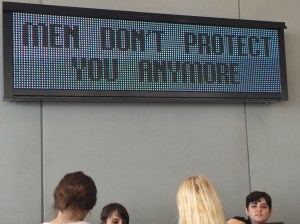
This message can, of course, be interpreted in multiple ways. Here at Chez Jane, we see it as a reminder that women’s liberation comes, at least in theory, with new risks and new responsibilities for self-protection. While some women have resisted feminism precisely because they preferred the old patriarchal bargain that promised women some protection from poverty and men’s brutality, that bargain was kept intermittently at best, and often with serious strings attached. Feminists have always hoped that women could, individually and collectively, challenge the system that made economic survival and physical safety conditional on patriarchy.
Jenny Holzer’s electronic sculptures, projected statements, and her texts printed on Tshirts, electronic signs, and billboards are famous for their power, their insights, their sensitivity, and their willingness to traverse public and private, body politic and body. Holzer’s narrative statements render the invisible visible, voicing what we might be thinking in silence. Holzer makes up her own statements, but more recently has worked with texts written by others. Sure, these texts are often from literary greats or declassified military documents, but we can’t help hoping that our own statements become Holzerisms in LED lights:
WHY ARE YOU WAITING FOR A BYSTANDER TO SAVE YOU?
SEXUAL LIBERATION COMES WITH THE NEED FOR SELF-DEFENSE
FIGHT THEM OFF
I HAVE THE RIGHT TO BE MY OWN BYSTANDER
MY RESISTANCE DOESN’T REQUIRE YOUR APPROVAL
I AM THE ONE WHO CHOOSES MY BOUNDARIES
MY RESISTANCE CHANGES THE RAPE CULTURE
ONLY I MAKE MY SEXUAL CHOICES
SEE JANE FIGHT BACK; SEE DICK RUN
If Jenny Holzer ignores these Jane-generated #Holzerisms, we will settle for dominating the feminist fortune cookie industry.
And really, if any of you would like Jane’s printable feminist fortunes with our favorite recipe for homemade fortune cookies, just say the word and it’ll be our next blog post.
Hey, CDC: Friends Don’t Let Friends Deny the Effectiveness of Self-Defense Training
The CDC is going to have an increasingly difficult time ignoring the data that show how effective self-defense training is for reducing completed sexual assaults. As Dr. Jocelyn Hollander points out in the Huffington Post, “the CDC has steadfastly refused to consider self-defense training as part of its approach to preventing sexual violence. And because other major organizations – including the White House Task Force to Protect Students from Sexual Assault and a large number of universities and colleges – rely on the CDC for their research, self-defense training has been completely left out of the current rush to develop effective prevention strategies, especially on college campuses.”
The CDC’s approach is a public health approach, which means they want to use data-driven methods to prevent the problem of sexual assault–including changing the cultural norms that support and perpetuate the problem. For some reason, the CDC and others have either not known about the research on self-defense or they have been aware of the research but dismissed it as not truly prevention-oriented. After all, CDC researcher Dr. Sarah DeGue stated skeptically that a man who finds himself thwarted by a woman who defends herself against his aggression could move on to a woman who is untrained or otherwise more vulnerable. Thank goodness public health officials didn’t see the polio vaccination that way. Not everyone has to be vaccinated to make a major dent in a public health problem.
Ok, not really the same thing? After all, rapists aren’t infections or diseases; they are oppressors. Well, thank goodness the ACLU doesn’t use this logic on oppressive abuses of social and political authority. If they did, they’d have no interest in educating people about their civil liberties and instead would say that such efforts are futile since a government official or corporation could only find someone who does not know their rights to oppress.
OK, then what about victim-blaming, or as countless newspaper articles have put it this past week, “putting the ONUS ON WOMEN to prevent sexual assault”? Thank goodness the American Red Cross doesn’t see it this way. If they did, they’d have little reason to certify water safety instructors and offer water safety classes to children. They do this because they know that learning to swim helps prevent drowning. As parents who had the onus of taking children to a public pool for Red Cross swim lessons (and onus is appropriate here because they didn’t always want to go, and when they did we went through this ritualistic struggle as a candy machine was parked strategically outside the swimming pool entryway), we must say that it would be nice if we didn’t have to worry about our children drowning. But we do–and hey, it turns out swimming is pretty darn fun, good exercise, and overall has multiple benefits. We think the same is true of self-defense.
Jocelyn Hollander gives this analogy: Imagine if researchers discovered that there was a way car drivers could reduce auto accidents by 50%. Would we not promote that strategy on the grounds that car companies should make the cars safer so drivers don’t have to do that? Would we not promote that strategy on the grounds that it puts the onus on drivers and could result in blaming victims of auto-accidents, not all of whom will engage in the safety strategy? Let’s hope not.
The point of the ecological public-health model is to use multiple methods to get at the root of a problem. Offering self-defense training is how we will do that. Ignoring self-defense or dismissing it as not truly preventative might ultimately turn out to reveal that unlike a polio vaccine, unlike swim lessons, and unlike knowing your rights, self-defense training involves a major disruption to the gender status quo. We don’t mind young ladies knowing their rights. We even suggest they “know their nines” (understand their rights under Title IX). It’s aggressively asserting those rights that seems so, well, unladylike.
And that it does is exactly why it challenges more than an individual attacker but an entire culture.
Major Study Shows Self-Defense is Effective in Reducing Attempted and Completed Sexual Assaults
Prof. Charlene Senn and colleagues did a major study on college women who were trained in empowering self-defense and compared their outcomes with those in a control group who had no such training but only access to brochures on sexual assault. The study, just published in the New England Journal of Medicine and reported on in the New York Times today, found that those who took the program called “Enhanced Assess, Acknowledge, Act Sexual Assault Resistance” were victims of completed rape a year later significantly less than those in the control group (5.2% vs. 9.8%; relative risk reduction, 46.3%). The self-defense program also reduced the incidence of attempted rape (3.4% in the resistance group vs. 9.3% in the control group; relative risk reduction, 63.2%). In addition, incidences of nonconsensual sexual contact and attempted coercion were lower in the resistance group than in the control group.
Now, as we have been saying, the CDC’s public health approach to preventing sexual assault on college campuses insists that we use data-driven approaches that contribute to making population-level changes and that also change the cultural norms that support sexual assault. This new study and the press it’s getting make it impossible for the CDC to continue to suggest that there is simply no data on victim protective factors that will contribute to the prevention of sexual assault. Training women to resist sexual assault is a key protective factor. If the CDC ignores it and continues to stand by only bystander intervention training, then it will become obvious that ideological factors, not a lack of data, explain the CDC’s resistance to resistance.
The Hidden Curriculum of Campus Rape Prevention Education
With the new federal mandate that all colleges and universities receiving federal funds provide all new students and employees rape prevention education it’s critical that we examine what counts as “prevention” and ask why self-defense training is absent from the concept of prevention. This short video makes the argument that excluding self-defense results in a HIDDEN CURRICULUM we must challenge.
Bystander Training without Self-Defense Training: Teaching Protection of Others without Teaching Self-Protection
Video: One Photo, Six Words on Self-Defense
1 photo, 6 words: Self defense IS sexual violence PREVENTION! #seejanefightback We asked, you delivered! Here is our video –a response to the CDC’s “Veto Violence” video.
In March 2015, the CDC put out their “1 photo, 6 words”: #VetoViolence video, to tell the public-health story of preventing violence against women by stringing together some of the photos people posted under the hashtag #VetoViolence with six words about preventing sexual assault. While we agree with statements in that video such as “Violence against women is not cool”, “Gender equality should be the norm”, self-defense was COMPLETELY ABSENT from their story. But self-defense IS ABSOLUTELY PART OF the public-health approach to preventing violence against women.
Thanks to all of you who sent us your photo with six words about self-defense for #seejanefightback!!!
Watch our one-minute video here!
And, keep the images coming– just post to your own Facebook page with the hashtag #seejanefightback.
Your Official Bad-Ass Kick-Ass Warrior Name
If you already know your “porn name” (name of your first pet + name of the street you grew up on) or your rap star name, you probably ought to know your official bad-ass kick-ass warrior name, courtesy of See Jane Fight Back.
Start with The Great and then + the first 3 letters of your first name + zilla; then take the first 3 letters of your last name + titude.
And thus, Jill Cermele becomes The Great Jilzilla Certitude. And you really can’t get more kick ass than that. But your own name will be bad ass, too. Please let us know what it is or post it to Facebook. We’ll find it if you just include #seejanefightback.
xo
 See Jane Fight Back
Recent Comments