Picture Yourself Rotating THESE in Space
Remember those images of shapes broken up into little square boxes, and the multiple choice test asking you to picture the same shape rotated differently? 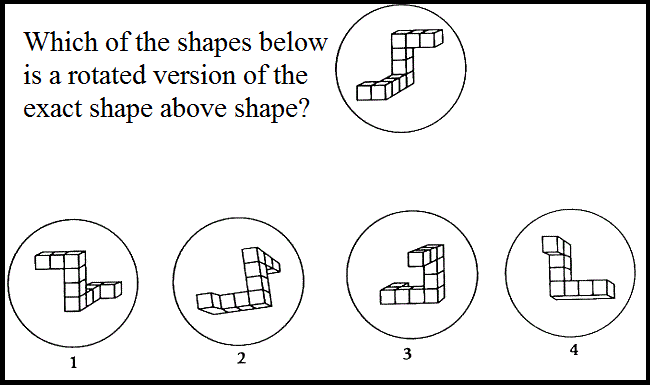 Such spatial reasoning is a stereotypically male skill. Well, a study out of the University of Berlin shows that women who were asked to imagine themselves having stereotypically masculine personality traits–strength, risk taking, assertiveness, and the like–performed as well as male peers on the spacial reasoning test immediately following this picture-yourself-as exercise, while women who were asked to imagine themselves having stereotypically feminine personality traits–agreeableness, caring for others, etc.–performed much lower than male peers on the special reasoning test right afterward.
“Gender priming” influenced women’s performance, big time.
This reminds us that allowing women to imagine themselves with the assertiveness and entitlement to fight back against an assailant can make an appreciable difference in their actual ability. If you can picture testicles rotated in space, you might be more likely to be able to actually rotate them in space if a guy you’re with won’t take no for an answer.
Wonder Woman – did you hear…?

Dear Wonder Woman,
In light of the recent news story, and given that we do not know the degree to which you are tapped into the media buzz (although we did see you on Facebook), we are reaching out to you. Did you know there is a story in the news that your image has been banned at one elementary school (name and location are being withheld to protect the ridiculous); this in response to a young girl who brought in a Wonder Woman lunch box, which was considered to depict, and we quote, a ”violent image”, because as a super hero, you, and we quote again, “solve problems using violence”.
Care to comment?
The Janes
Dear Janes,
WTF? Don’t quote me on that – as it’s probably “too violent”. But seriously, WTF? I’m a superhero. I fight evil – and, I might add, I do a damn good job of it. How am I supposed to do that, with smiles and unicorns? With polite requests for changes in behavior? How’s this: “That’s just not nice. Please, please, stop your evil ways?” Should I shed a few tears while I’m at it? That’s not fighting evil – that’s offering a label, begging for change, and then hoping for the best. No way. Being a female superhero is hard enough without having to deal with this.
WW, a.k.a. Dub-Dub
Dub-Dub,
We feel your pain. And definitely don’t beg – the data tell us that strategies like that are not effective in resisting violence. We, like you, are tired of people saying that active resistance is bad, and particularly, bad when women do it. We think you’re a role model – we want more, not fewer, girls and women to follow your example, and know that they have the right to resist. Buying your lunch box right now on Amazon.
The Janes
On that note, Janes, what problems do they think I’m “solving” with violence? Disagreements on what to have for dinner? Not getting the job I wanted? Algebra? When we frame evil-doers intent on world domination as a just any “problem to be solved”, it’s no wonder that everyone gets confused. I match my tactics to the situation at hand. Read my bio – sure, I can fight, and I do when I need to, and I’m not apologizing for that. But that would only be my first strategy if I was physically threatened and that response was appropriate. Duh. I’m wicked smart, and I’ve got excellent verbal skills – both of which are incredibly useful in, as that school system might say, “solving problems”. As for weapons, I’ve got a lasso of truth and bracelets that deflect bullets. If that’s solving a problem with violence, guilty as charged.
WW
PS. Besides, are my boys Batman, Spiderman, Iron Man, Superman, the Hulk, and Captain America being banned as too violent? Not that I am suggesting they should be. More likely, not only are they not being banned, they are probably making more money than I am.
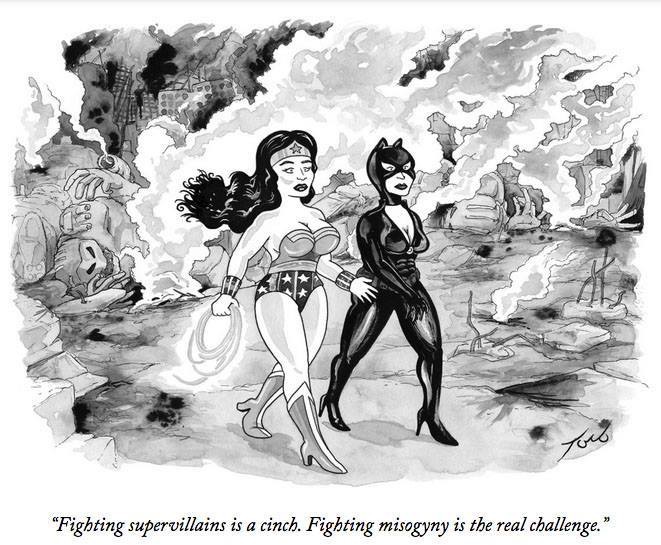
Top Ten New Signs to Hang on College Frat Houses on Move-In Day
There has been significant media coverage of the signs that a fraternity at Old Dominion and an all-male house of Ohio State students hung out their house windows this week to “welcome” the first-year women to their campuses. Signs like, “ROWDY AND FUN. HOPE YOUR BABY GIRL IS READY FOR A GOOD TIME!” and “DAUGHTER DAYCARE.” And posters for sale in the Student Union at Appalachian State this fall included this gem:

Good for these guys! We applaud their truth in advertising, letting the incoming women, their families, and the college communities at large know that they are predatory groups of men looking to score with wiling women, or maybe even coerce or assault women who aren’t willing. It’s an important step in acknowledging the violence and misogyny that too often accompanies life in all-male social clubs.

 5. WELCOME TO THE HOUSE OF EXTRAVAGANT FREEDOM AND SCANT RESPONSIBILITY!
What You Really Need to Know About the Freshman 15
As September approaches, young people gearing up for college are inundated with information about freshman year – what NOT to buy for your college dorm room, tips for getting along with your new roomie, how to/why you’ll love freshman year, how to drink at college parties, and of course, the Freshman 15.
Now, all the data tells us that the Freshman 15 is a myth – the average weight gain for students is around 3 lbs (the same as for non-students of the same age), but the problem of sexual assault is not a myth. So we here at SJFB are shamelessly co-opting the phrase “Freshman 15” to give you the top 15 things you actually need to know as college students, first year and otherwise:
- You get to decide what you do with your own body. That’s right – whether it’s what you eat or who you’re with and what you do, that choice is yours, and yours alone, as long as you’re not deciding something for someone else’s body in the process.
- Trust your gut. Take the time to learn how you feel, and pay attention to it. If something, or someone, doesn’t feel right, it’s probably not, and you get to leave any situation or person that doesn’t feel right for you. As they say, there are plenty of fish in the sea (or…carrots in the field, for the vegetarian/vegan crowd…)
- See the options around you. Good advice for anywhere on campus, not just the cafeteria. Take the time to survey who and what is around you, and if something – or someone – isn’t working for you, know that you can choose a different option, whether that is where to live, where to socialize, or who you are spending time with.
- Get the facts. Even in college, and even about sexual assault, misinformation abounds. Don’t rely on what’s right in front of you – whether in conversation with friends, a statement by a professor, or a sign on the door in the bathroom stall. Fact: fighting back can be extremely effective in thwarting an assault – it’s a right you have, and a choice you can make if it feels right to you.
- Tweak your lifestyle. – For the better! Make choices (not just food!) that are good for you, and surround yourself with people who are interested in what you want for yourself, not just what they want from you.
- Swap your go-to order. Old habits die hard, and we often go with what feels familiar, rather than what feels safe and healthy. If what you’ve done before doesn’t feel good now, try something new.
- Skip the stupid aisle. Okay, in the diet magazines, they will you to “skip the salty aisle”, but we like this better. College – like life – is too short to waste with stupid people, and by that, we mean people who are interested in bringing you down to their level. Trust us – there are better aisles out there.
- Do a purge. One nice thing about college is that you get to leave high school (and middle school) behind you. We’ve all made mistakes in the past, and we will make them in the future. Don’t let them define you – a figurative purge allows you to let those go, and move forward in the direction you want.
- Healthy up your happy hour. As we’ve said before, alcohol is complicated. The connection between alcohol and assault on college campuses is well-documented, which in no way means that drinking or being intoxicated makes a person assault someone else, or makes a person responsible if someone assaults them. Know, whether or not you choose to drink, that it is important to know your limits and the risks associated with alcohol use.
- Pile on the boundaries. You get to “no” to things you don’t want, without disclaimer, explanation, or apology. As scholars who write for a living, we are here to remind you that “No” is a complete sentence. (And remember – what’s posted on-line STAYS on-line. Err on the side of caution.)
- Show some restraint when appropriate. Whether in person or on social media, remember that you are not obligated to please others at the expense of your own happiness and well-being.
- Get off the couch. Staying physically active in college is a great way to manage stress and manage your moods. Stay focused on exercise that makes you feel better—not whether it makes you look better.
- Know what you stand for. Notice injustice and oppression in your environment – your own personal space, and the world at large – and decide how you can respond to it safely. Being in college is just like being in any other community: there will be conflicts, tragedies, and triumphs. And what kind of community member you choose to be will help shape what that community becomes. Part of a group or club doing something deplorable? Take a stand—change it, report it, leave it.
- It’s always okay to ask for help. Whether it’s help with your writing skills, with depression or anxiety, or in a situation that feels unsafe, ask for what you need. You may be living on your own, but you’re not an island. College campuses have more resources than ever to support your well-being and your academic success. Know the resources out there, and don’t be afraid to use them.
- Get fired up. Take the time to get to know yourself, and then go for it, full steam ahead. Know what you want – and don’t want – and keep your eye on the prize. You’re in college to be an academic rock star and pursue your dreams. College is about making your future, so evaluate every option or course of action based on whether it will help, or hinder, achieving your goals. Believe in yourself. We believe in you.
It’s time for another lesson from the University of the Bleeding Obvious.
Back when Miss USA, Nia Sanchez (we love you, Nia, even if you won’t return our phone calls), said that to combat the problem of sexual assault on college campuses more women should be offered the opportunity of self-defense training, feminist-identified pundits with access to HuffPo interviews flipped out. The concerns varied: some said that recommending self-defense training is putting the onus on women (rather than men) to prevent rape; others argue that self-defense training wouldn’t work because the likely perpetrator is someone known to the victim, and that’s not the “mind-set” for self-defense.
But the real head scratchers were those who rejected self-defense training on the grounds that it ran counter to feminine socialization. They understood that the fact girls and women are trained to subordinate their interests to boys and men, and that this feminine socialization interferes with defending themselves. Indeed, self-defense training is all about NOT subordinating your interests to men and boys. So opposing the recommendation to offer women self-defense training on these grounds (http://www.huffingtonpost.com/2014/06/11/miss-usa-self-defense_n_5482117.html) seems to presume that we self-defense teachers and advocates do not understand this. What do they think, that self-defense teachers just show women a punching bag, offer them some chewing tobacco, and say “have at it”?
Let’s offer those most likely to be targeted for sexual assault the skills to intervene on their own behalf. Yes, for many of these people, and women in particular, such skills will contradict their socialization into femininity. Self-defense training is a kinesthetic experience that rattles the feminine training so tragically well suited to rape culture. That’s exactly what we like about it and why it’s so transformative beyond the individual women it helps.
DR. SEUSS’S SELF-DEFENSE STORY
Not in a box, with a fox, not on a train, but on a blog with Jane…
Everyone is excited about the recently discovered orphaned Dr. Seuss story. Dr. Seuss was an awesome, politically progressive storyteller. For example, Horton Hears a Who and The Lorax deal with environmental protection; The Grinch Who Stole Christmas is a critique of consumerism; The Sneetches is about the rich using cosmetic surgery to distinguish themselves and the technologists who profit from their efforts; and The Butter Battle Book is about prejudice and discrimination.
Ranking in the top 10 best selling Dr. Seuss books of all time is Green Eggs and Ham; ostensibly about a picky eater, it can also be read as a commentary about male sexual entitlement, with green eggs and ham being a thinly veiled reference to unwanted sexual intercourse. Sam-I-Am just pushes and pushes (“do you like them in a car? do you like them in a boat? with a goat?” etc.) until the other person finally gives in and, in a reversal of fortune typical of a porno, that person enthusiastically declares green eggs and ham likable after all.
That’s why we believe the Dr. Seuss story to be released today is the second part of Green Eggs and Ham and will be about women’s empowerment, as follows:
I am Sam. Sam-I-Am.
That Sam-I-Am, that Sam-I-Am. I do not like that Sam-I-Am!
Do you like green eggs and ham?
I do not like them,
Sam-I-Am.
Now, go away! You heard me – scram!
Would you eat them with an elf? The one who sits up on that shelf?
Not even with a little green elf.
Do you need me to repeat myself?
Maybe if you have a drink?
Then you’ll change your mind, I think.
If you get drunk as a skunk
You’ll eat green eggs and ham, I thunk.
Not with some drinks
Your hearing just stinks
Not with an elf
I decide – myself!
I do not like green eggs and ham.
AND I do not like YOU, Sam-I-Am
I do not like them, drunk or not.
So I will not eat them; not a shot.
What if I dim the lights and get you solo?
Then you’ll eat them – this I know.
Not with the lights dim.
Not with the lights bright.
Not in the day.
Not in the night.
Not in a plate or on a cone.
Now I want you to LEAVE ME ALONE!
How about in a bed—or on a train?
You’ll eat them then, without complaint.
Not in a bed or on a train.
I tell you, Sam, this is in vain!
But all the same,
How about in a tree?
In a tree you’ll like them; you will see.
Not at all, now let me be!
What if I now turn on the charm?
You’ll like them – and me – what is the harm?
Just one jump into the sack?
You say no now, but you’ll take it back…
Take it back? No, I’ll take your arm….
And bend it back to cause YOU harm.
I’ll get in your face and let you see
You really must take me seriously.
I’ll kick your legs
And you’ll stop asking about eggs
And as I deliver a

You stop talking about ham.
So listen closely, Sam-I-Am
Before you’re truly in a jam.
I will not eat them with an elf
Not with you, not by myself
I will not eat them drunk or sober
So back off now; this talk is over
I will not eat them day or night
And when you don’t stop, I’m gonna fight.
Not in a train, not on a bus
Not in a bed, not if you cuss.
I will not eat them here or there
I will not eat them ANYWHERE
I, not you, choose what I eat
What I wear, with whom I sleep.
And I do not want your green eggs and ham.
I’m done with you, now, Sam-I-Am.
MEN DON’T PROTECT YOU ANYMORE
“MEN DON’T PROTECT YOU ANYMORE” is the statement on a large electronic sign that greets you as soon as you walk into The Whitney Museum at its gorgeous new location in NYC’s meatpacking district. The sign, hanging above the ticket purchasing area, is one of many statements done in LED lights by American feminist conceptual artist Jenny Holzer.
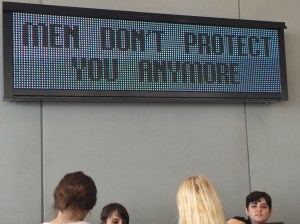
This message can, of course, be interpreted in multiple ways. Here at Chez Jane, we see it as a reminder that women’s liberation comes, at least in theory, with new risks and new responsibilities for self-protection. While some women have resisted feminism precisely because they preferred the old patriarchal bargain that promised women some protection from poverty and men’s brutality, that bargain was kept intermittently at best, and often with serious strings attached. Feminists have always hoped that women could, individually and collectively, challenge the system that made economic survival and physical safety conditional on patriarchy.
Jenny Holzer’s electronic sculptures, projected statements, and her texts printed on Tshirts, electronic signs, and billboards are famous for their power, their insights, their sensitivity, and their willingness to traverse public and private, body politic and body. Holzer’s narrative statements render the invisible visible, voicing what we might be thinking in silence. Holzer makes up her own statements, but more recently has worked with texts written by others. Sure, these texts are often from literary greats or declassified military documents, but we can’t help hoping that our own statements become Holzerisms in LED lights:
WHY ARE YOU WAITING FOR A BYSTANDER TO SAVE YOU?
SEXUAL LIBERATION COMES WITH THE NEED FOR SELF-DEFENSE
FIGHT THEM OFF
I HAVE THE RIGHT TO BE MY OWN BYSTANDER
MY RESISTANCE DOESN’T REQUIRE YOUR APPROVAL
I AM THE ONE WHO CHOOSES MY BOUNDARIES
MY RESISTANCE CHANGES THE RAPE CULTURE
ONLY I MAKE MY SEXUAL CHOICES
SEE JANE FIGHT BACK; SEE DICK RUN
If Jenny Holzer ignores these Jane-generated #Holzerisms, we will settle for dominating the feminist fortune cookie industry.
And really, if any of you would like Jane’s printable feminist fortunes with our favorite recipe for homemade fortune cookies, just say the word and it’ll be our next blog post.
College Rape Prevention Program a “Rare” Success? An Open Letter to Jan Hoffman at the NY Times
Dear Ms. Hoffman,
In “College Rape Prevention Program Proves a Rare Success”, you concluded an otherwise empowering, data-driven piece on the effectiveness of self-defense by trotting out a quote from Kathleen Basile at the CDC, who ignores the data in suggesting that self-defense training places the “onus for prevention on potential victims”. Self-defense is a key protective factor in rape prevention, as Senn’s data clearly demonstrate; no disclaimer required. It is no more problematic to suggest women have the option of self-defense training than it is to suggest that women do a self-exam for breast cancer or wear sunscreen when they go outside. The only difference is that we are far less comfortable with the idea of women’s use of defensive violence than we are with other, kinder, and gentler ways that we support women’s self-care.
The responsibility for rape lies with the perpetrators; suggesting that self-defense somehow shifts that responsibility to the victim is what is misguided and victim-blaming, not the option of self-defense for women.
PROTECTING YOUR HOME – BUT AT WHAT COST? THE TOP 6 REASONS NOT TO GET A HOME ALARM SYSTEM
We at SJFB are getting a little tired of the latest backlash against self-defense, and the knee-jerk responses, by feminists and non-feminists alike, to Dr. Charlene Senn’s study out of the University of Windsor on the effectiveness of self-defense training in reducing the likelihood of attempted and completed assaults against college women, which was published in the New England Journal of Medicine.
It’s easy to dismiss self-defense training and women’s capacity or powerful, effective resistance: it rocks the status quo in a way that other responses to rape and sexual assault, like marches and t-shirts and performance art, just don’t. But the responses reflect our cultural discomfort with women’s empowerment and entitlement to self-defense far more than any logic or data.
Not convinced? Change the topic to home alarm systems – an option that some people choose as a way to minimize or thwart burglaries or home invasions.
- IF A WOMAN HAS TO GET A HOME ALARM SYSTEM, THAT WILL ONLY MAKE HER FEEL FEARFUL, SMALL, UNSAFE, AND SELF-RESTRICTING IN HER OWN HOME.
- IT MIGHT NOT WORK (AND IF IT DOESN’T WORK, IT WILL RESULT IN BLAMING HER FOR NOT HAVING GOTTEN ONE THAT WAS MORE EFFECTIVE.)
- SHE MIGHT FORGET TO TURN IT ON, AND THEN IT WILL BE HER FAULT IF SOMEONE BREAKS INTO HER HOME
- IF SHE HAS A HOME ALARM SYSTEM AND HER NEIGHBOR DOESN’T, THEN AN INTRUDER MIGHT JUST LEAVE HER HOME AND MOVE ON TO HER MORE VULNERABLE NEIGHBORS, AND THEN IT WILL BE HER FAULT IF SOMEONE BREAKS INTO THEIR HOMES.
- NOT EVERYONE HAS THE OPPORTUNITY TO GET A HOME ALARM SYSTEM, AND SO WHAT ABOUT THOSE PEOPLE?
- GETTING A HOME ALARM SYSTEM IS AN INDIVIDUAL SOLUTION TO THE SOCIAL PROBLEM OF CRIME AND UNFAIRLY PLACES THE ONUS FOR CRIME PREVENTION ON THE HOME OWNER
Ridiculous, right? No one has to or can get a home security system, but we don’t challenge anyone’s right to get one, and we don’t worry about victim-blaming, or the (undocumented, unsupported-by-the-data) fear of putting others at risk by choosing to get one. And we certainly don’t suggest people don’t get one because it’s not the end-all, be-all solution to crime.
Sure, our bodies are quite not property that we live in and need to protect from robbers. But the analogy works to show how flimsy the knee-jerk reactions to Senn’s self-defense study are.
Instead, let’s celebrate this data – that self-defense training for college women can effectively reduce their risk of assault – and put that in the context of all the other data on the efficacy of self-defense in thwarting rape. Let’s put our energy instead into demanding that organizations, educational institutions, and governments make funding available so women and girls have the option, not the onus, of self-defense training. That’s the cost to focus on, because we know the cost of violence against women. Last year, the CDC had a budget for sexual assault prevention of about $50 million dollars. That could fund a heck of a lot of self-defense classes.
Hey, CDC: Friends Don’t Let Friends Deny the Effectiveness of Self-Defense Training
The CDC is going to have an increasingly difficult time ignoring the data that show how effective self-defense training is for reducing completed sexual assaults. As Dr. Jocelyn Hollander points out in the Huffington Post, “the CDC has steadfastly refused to consider self-defense training as part of its approach to preventing sexual violence. And because other major organizations – including the White House Task Force to Protect Students from Sexual Assault and a large number of universities and colleges – rely on the CDC for their research, self-defense training has been completely left out of the current rush to develop effective prevention strategies, especially on college campuses.”
The CDC’s approach is a public health approach, which means they want to use data-driven methods to prevent the problem of sexual assault–including changing the cultural norms that support and perpetuate the problem. For some reason, the CDC and others have either not known about the research on self-defense or they have been aware of the research but dismissed it as not truly prevention-oriented. After all, CDC researcher Dr. Sarah DeGue stated skeptically that a man who finds himself thwarted by a woman who defends herself against his aggression could move on to a woman who is untrained or otherwise more vulnerable. Thank goodness public health officials didn’t see the polio vaccination that way. Not everyone has to be vaccinated to make a major dent in a public health problem.
Ok, not really the same thing? After all, rapists aren’t infections or diseases; they are oppressors. Well, thank goodness the ACLU doesn’t use this logic on oppressive abuses of social and political authority. If they did, they’d have no interest in educating people about their civil liberties and instead would say that such efforts are futile since a government official or corporation could only find someone who does not know their rights to oppress.
OK, then what about victim-blaming, or as countless newspaper articles have put it this past week, “putting the ONUS ON WOMEN to prevent sexual assault”? Thank goodness the American Red Cross doesn’t see it this way. If they did, they’d have little reason to certify water safety instructors and offer water safety classes to children. They do this because they know that learning to swim helps prevent drowning. As parents who had the onus of taking children to a public pool for Red Cross swim lessons (and onus is appropriate here because they didn’t always want to go, and when they did we went through this ritualistic struggle as a candy machine was parked strategically outside the swimming pool entryway), we must say that it would be nice if we didn’t have to worry about our children drowning. But we do–and hey, it turns out swimming is pretty darn fun, good exercise, and overall has multiple benefits. We think the same is true of self-defense.
Jocelyn Hollander gives this analogy: Imagine if researchers discovered that there was a way car drivers could reduce auto accidents by 50%. Would we not promote that strategy on the grounds that car companies should make the cars safer so drivers don’t have to do that? Would we not promote that strategy on the grounds that it puts the onus on drivers and could result in blaming victims of auto-accidents, not all of whom will engage in the safety strategy? Let’s hope not.
The point of the ecological public-health model is to use multiple methods to get at the root of a problem. Offering self-defense training is how we will do that. Ignoring self-defense or dismissing it as not truly preventative might ultimately turn out to reveal that unlike a polio vaccine, unlike swim lessons, and unlike knowing your rights, self-defense training involves a major disruption to the gender status quo. We don’t mind young ladies knowing their rights. We even suggest they “know their nines” (understand their rights under Title IX). It’s aggressively asserting those rights that seems so, well, unladylike.
And that it does is exactly why it challenges more than an individual attacker but an entire culture.
 See Jane Fight Back
Recent Comments