Open Letter to Mr. Splashy Pants
Dear Mr. Splashy Pants,
Congratulations on being an amazing Internet meme. How’d you do it? You stand for a great cause–GreenPeace wanted to make people more aware of the whales that were threatened in Japan–and you emerged as the people’s choice for icons in this movement.
But you were the underdog (underwhale? underwear?). Most of the names for the representative whale were serious, symbolic, ethereal names like Anahi and Kaimana. And yet you prevailed, because GreenPeace left it up to a vote over social media. When you won, GreenPeace pulled the old “we’re going to keep the contest open a while longer” trick, at which point your supporters only became more emboldened, determined to see their beloved Mr. Splashy Pants the name of the GreenPeace whale.
That’s why we’re writing you for advice, Mr. Pants, in hopes that we could make the kind of splash on social media that you have. We’ve blogged serious stuff. We’ve blogged silly stuff. We’ve submitted a video in response to the one that the CDC did. We just don’t have your supporters or your success. But we know, Splashy, that you understand the importance of self-preservation, and fighting back against those who would perpetrate violence. We know you get it, Splashy.
Please write with any suggestions as to contests &etc. Thank you.
Sincerely,
Jill & Martha
Swimming in White Privilege
D. L. Hughley, Black comedian and author of the new book Black Man, White House, was interviewed the week of Aug. 11, 2016 on the Tavis Smiley Show. Now, D. L. Hughley’s earlier book is called We Want You to Shut the F#ck Up, so we (a) already like him and (b) know to expect a degree of comedic audacity and brutal honesty. That said, we really appreciated his jokes during the show about how White privilege informs expectations for safety. Hughley brought up the cases from earlier this year when children tragically wandered into the zoo enclosure of the silverback gorilla and into the alligator-infested waters near Disneyworld.
“It is ridiculous the things that you see. Like when I watch what happened with the tragedy with the alligator. When a sign says ‘Don’t swim,’ don’t swim! . . . . Alligators don’t read signs! . . . But I know what, when Black people see a sign that says ‘don’t swim’ you best believe we ain’t swimming. That’s why they got a pool, right?! [Imitating a parental voice] ‘You better dip your toe in that bathtub and shut up, we’re at Disneyworld.'”
Perhaps some would criticize Hughley for “blaming the victim” of such tragedies, but a truth his comedy reaches links the expectation of safety from others in the world to White privilege. Blacks, his shtick implies, have never been able to expect institutions and authority figures to guarantee their safety. They have, instead, taught one another to watch out for dangers. Black parents should not have to have “the talk” with their children, especially their sons, but they do. They know that Black boys and men are far more likely than Whites to be targets of police brutality.
We know that women (of all races) are far more likely than men to be targets of sexual assault. Offering girls and women tools for being on the lookout for signs of danger is just as rational a response to a violent and unjust world. That’s why the many rape prevention educators who preach bystander intervention whilst refusing to talk about how women can learn to defend themselves sound like people who have had a privileged protection to the point of paralysis. How about we make it easier for women to be aware of their surroundings, and act on their awareness, assert themselves, and hit or kick if necessary to get out of an attack? Nope- that’d be victim blaming, we’re often told. Women should be able to walk across their college campuses naked, and defenseless, we are told. How about we shift our understanding of ourselves as powerful and empowered, and able to make choices that challenge rather than support the patriarchy? That’s what self-defense training can do.
We know, we know. You can’t train an alligator but you can (supposedly) train men to be different, and less dangerous. This might be true, but self-defense training will work a lot faster than your training of men. And guess what? When women watch out for themselves, take themselves seriously, and defend their own safety, that sends a powerful “training” message to the men in their midst.
An Open Letter to Rape Prevention Educators
Dear Rape Prevention Educators,
As rape prevention educators, you emphasize “primary prevention,” but do not include self-defense or resistance as such. Self-defense, you say, is “secondary prevention”–along with providing counseling and medical care to victims of completed rape. As we have already argued, this is not a data-driven approach because the data show that self-defense is an effective sexual assault prevention strategy, and it is ultimately fueling a disempowered status for women on campus.
Why wouldn’t you tell people that training in self-defense is possible and that research shows that active resistance to attack, with or without prior training, usually works to thwart an assault?
Some of you think it’s violent, and therefore it counters your program “against violence”. If that’s the case, there’s an easy solution. How about you clarify that you’re against sexual assault? You’ll be glad to learn that data show that women learning how to resist violence perpetrated against them results in an overall reduction in such violence. Self-defense is part of the effort to stop oppressive violence.
Some of you object to women having to do anything for their own health and safety. Well, except when it comes to the importance of preventing pregnancy and STI’s, or when it comes to smoking cessation, or when it comes to curbing one’s risk for breast and cervical cancer. In fact, most of you are all about checking your breasts, getting route health screenings, and stopping life-shortening and life-threatening habits like smoking tobacco. We’ve never heard any of you declare, “I shouldn’t even have to get a pap smear!” or “I should be able to smoke all the cigarettes I want!” or “I mean, if a woman wants to use protection against pregnancy or STIs while she is having sex with multiple partners whose sexual history is unknown to her, that’s up to her–but I’m not going to suggest that anyone do that!” So clearly, if you are in favor of women acting to promote and protect their own health and safety, you can support self-defense and self-defense training.
Some of you think talking about women’s ability to resist attack is victim-blaming. But teaching women to be proactive about their own health and safety, and to take their own bodily boundaries seriously, is not blaming anyone who becomes the victim of attack–attempted or completed. In fact, self-defense is often taken by survivors of sexual violence, and it does not make them blame themselves for what happened. It gives them new options for responding and helps them take some of their power back. It’s therapeutic. It’s therapeutic for others who take it, too, because they learn boundary setting, taking themselves seriously, and yes, the physical stuff and the yelling can be really cathartic and fun. Besides, we’d rather risk a few women feeling bad or blamed than risk lots of women becoming victims because everyone was more worried about women feeling blamed than about women getting raped.
If we’re going to teach people to stop a guy who is about to rape someone, and call that primary prevention, and also not call it violence (even though, um, let’s just remember that the heroized bystanders who intervened during the rape being committed at Stanford used physical force to intervene), then teaching those who are targeted for rape how to stop someone who’s about to rape them is no less primary, and no more violent, than what we’re already teaching.
We still don’t know the difference between the whip and the nay-nay, but we do know the difference between primary and secondary prevention. Do you?
Don’t You Wish Obama Had Really Said This?
You can make Obama say anything you want thanks to techie geeks who invent cool apps. Don’t you wish he had really said this in connection with his Task Force on campus sexual violence?
http://talkobamato.me/synthesize.py?speech_key=4c4b3f83d6ac956864b42cd108fe4902
Thanks, Talk Obama to Me! You said it–er, we said it, and wish he’d said it……
Pro-Feminist Men CAN Support Women’s Self-Defense
Open Letter to Prof. Tal Peretz
Dear Prof. Peretz,
We value your work in the areas of men’s anti-sexist and anti-violence activism. As a sociology professor at Auburn, you were quoted in the LiveScience article about the science of preventing campus sexual assault. We admire your work advocating that we teach children about consensual behaviors on the playgrounds and in their homes.
However, we were very disappointed to read the quote from you, just after the reporter describes the incredible results that Charlene Senn’s empowerment self-defense training has, that
“We have far too much ‘here’s how you protect yourself’ [programs], when it’s not women’s job and not their fault. That whole way of talking about it really places the blame on women, when it should be on the rapists.”
Training women in how to set boundaries is just as important as your work training boys and men in how to honor boundaries others set. So don’t worry, you will not lose your job if you also endorse women’s self-defense training. As we have said to the late Kurt Cobain, both-and! You can both insist that we train men not to rape AND train women to resist any men who missed our memo.
Self-defense training does not place any blame for assault on women. If you really want to support feminism and fight for gender equality, please re-examine your belief that there are too many self-defense/self-protection programs out there.
Sincerely,
Profs. Martha & Jill
Fear, Inc.
This great piece by Susan Schorn, “Fear, Inc.,” published on McSweeney’s Internet Tendency, is worth reading. While Schorn here focuses on the marketing of emergency preparedness supplies and gadgets–you know, like the ones for the zombie apocalypse–we are reminded of the many who have attempted to market self-defense devices to women simply by harnessing that culture of fear,  attempting to make women feel even more afraid of male violence and even more vulnerable than they already do, and then selling them their product based to assuage the fear they just sparked. Those hairy legs tights never really did take off, did they?
Our favorite is Sarah Haskins’s hilarious video parodying ads for home security systems.
Of course, empowerment-based feminist self-defense might cost some money (instructors do have to be paid), but it’s not about inducing fear or making women feel more vulnerable. Perhaps some of the resistance to advocating women’s self-defense training has to do with it seeming like too close a cousin to the prepper movement.
You Won’t Find Self-Defense Mentioned Here Either
Last week all the employees at my workplace were sent an email offering us a service to help us achieve work-life balance. No, it was not a raise, a massage, a paid week off, or a nanny. It was the ability to subscribe to ComPsych Corporation’s GuidanceResources Online Web site. Once you register, you are promised access to useful information, news, interactive materials, and services in your area.
By the company’s own description, “GuidanceResources Online is home to hundreds of articles, assessment tools and multimedia presentations on a wide variety of topics.”
Need a carpenter? On there. Need to find childcare? There. Tips on coming out a work? Yep. Advice on why monogamy is the best and why cheating is a bad idea (and, let’s face it, will make you a less productive employee)? Indeed. It’s as if Oprah had invented this herself!
But no, there is no advice on having a successful and happy polyamorous relationship.
Nor will you find information on self-defense. Through the search function no information on “sexual assault” comes up. But searching on “rape” several articles come up. Here they are.
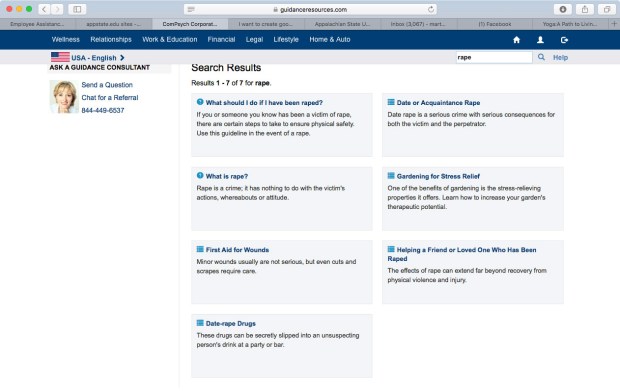
Gardening? Seriously? And take care of cuts and scrapes but no need for a rape kit…. Of course self-defense training is not listed as one of the prevention efforts to engage in. Let’s quote in full the “Date or Acquaintance Rape” page:
Date or Acquaintance Rape
Date rape is a violent crime with serious consequences for both the victim and the perpetrator. Continuing to force sexual activity after being told no is considered rape and is punishable under the law.
Date rape can be especially hard for victims to deal with because it is often committed by a friend or acquaintance. Like other forms of rape, date rape is not about sex; it is an act of violence in which power and control are the underlying motivating factors. Counseling through a rape crisis center can help victims cope with the trauma and make informed decisions about their legal options.
Nobody ever thinks they will be in a situation where date or acquaintance rape could occur, but these tragic events happen to women every day. The following tips can help you avoid many dangerous situations:
- Provide your own transportation to and from your date. This asserts your independence and makes it easier to get away from an unpleasant or dangerous situation. Carry cab fare and a cell phone when possible.
- Refrain from drinking alcohol or taking drugs. Be especially wary of situations in which games or contests encourage drinking lots of alcohol in a short time. Alcohol and drugs often are present in date-rape situations. For the victim, use of these substances can impair judgment, memory and ability to sense an unsafe situation developing. Some date rapes occur after the victim has passed out from too much alcohol. Drugs and alcohol also may cause the perpetrator to become more sexually aggressive.
- Be extra cautious about what you consume. The increased use of date-rape drugs like Rohypnol poses a real danger to your safety. Avoid beverages that are not sealed or were not prepared in your sight.
- Be aware of your surroundings and avoid isolated areas. Remove yourself from the situation immediately if you are even the least bit uncomfortable.
- Examine your feelings about sex and establish your limits before you are in a sexual situation. Then communicate those limits clearly and forcefully.
- Do not give mixed messages; be clear. Say “yes” when you mean yes and say “no” when you mean no. If you have trouble doing this, counseling or assertiveness training can help.
- Do not worry about seeming impolite or causing a scene if you feel that your safety is threatened.
- Be aware of specific situations in which you do not feel relaxed or in control. Avoid attending or staying late at parties where men greatly outnumber women, especially when drinking is involved. If you do not feel safe leave the event early.
- Stick to dates in public places like movie theatres or restaurants until you get to know and trust your date. Try double dates or group dates until you feel comfortable on a solo date.
- Think twice before inviting someone home. Most date rapes occur in the victim’s own residence. Take time to develop a trusting relationship before going to your date’s house.
- Trust your instincts. Many victims report that they sensed things were not quite right but were embarrassed to act on their suspicions until it was too late.
If you have been or suspect you may have been a victim of date or acquaintance rape:
- Seek medical attention first. Go to your hospital emergency room or school health center to be examined. Be aware that showering can destroy evidence that you could use later to legally establish the identity of the perpetrator, should you decide to press charges.
- Consider talking to the rape unit at your local or campus police. Take a friend along for extra support.
- If you are not ready to pursue the matter legally, call a local rape hotline, and tell them about your experience. The Rape Abuse and Incest National Network (RAINN) runs a National Sexual Assault Hotline: (800) 656-HOPE or www.rainn.org.
- Consider ongoing counseling to help you deal with the long-term effects of this trauma.
- RAINN: http://centers.rainn.org
- National Council of Women’s Organizations: www.womensorganizations.org
©2014 ComPsych ® Corporation. All rights reserved. This information is for educational purposes only. It is always important to consult with the appropriate professional on financial, medical, legal, behavioral or other issues. As you read this information, it is your responsibility to make sure that the facts and ideas apply to your situation.
Upstream vs. Downstream
It’s amazing what we learn when we read outside our field. An article by William Scott (University of Bath, United Kingdom), “Public Understanding of Sustainable Development: Some Implications for Education,” published in the International Journal of Environmental & Science Education (2015, 10:2: 235-246), reveals that those engaged with sustainable development efforts face many of the challenges those of us doing sexual assault prevention face.
Specifically, Scott and his colleagues feel that they’ve done too much “downstream remedial” work (measures that deal with the consequences of harm) and not enough “upstream prevention” work (interventions to address the underlying causes of problems). Sound familiar?
Scott describes an N.E.F. report, which “argues for prevention, and says that bottom-up prevention is best, with people and organisations becoming more resilient: building up their own immune systems, both literally and metaphorically, so that they become less susceptible to harm, changing attitudes and capabilities so that they are better able to take positive actions themselves.”
This is very much our approach with empowerment-based self-defense training. But just as with the other SD (sustainable development), with SD (self-defense) we find rather dramatic disagreement over whether it’s downstream remedial or upstream prevention. In fact, many feminists who are strongly interested in dismantling our rape culture do not emphasize SD on the grounds that it’s downstream remedial. We have long argued that SD can best be understood as upstream preventative.
According to Scott, that logic of prevention in sustainability education contradicts the “rescue principle” of so much philanthropy, charity, and health care. Rescuing people downstream can feel good but does not do the upstream prevention we need done. In that same way, bystander intervention programs, counseling services for victims, and training people to emphasize reporting on campus or in the workplace embody the rescue principle in rape prevention and education work.
Interestingly, Scott points out that many individuals and families are making efforts for sustainability, for instance by setting up a solar PV system. At the same time, only government can bring about macro-level change through “policy shifts, regulatory change, economic levers, and investment activity, for example.”
We, too, want macro-level change to the rape culture, and yet we also think individuals and groups practicing empowerment-based self-defense move us beyond the rescue principle and serves the effort of upstream prevention. Training women in self-defense may not be like taking the carbon out of electricity production, but it is at least as compelling as setting up your own solar PV system. We must do both for true prevention and social change. Self-defense training builds women up so that they are less susceptible to harm. Surely there’s no harm in that, other than to the rape culture.
Barbie Can Be Curvy, But Can She Fight?
Open Letter to Mattel:
Wow, Mattel, it like, took you long enough. Nothing like dwindling sales to respond finally to the zillions of critiques that Barbie was too skinny and buxom for girls to play with and still have a future free of eating disorders, and for their feminist mothers to agree to purchase.
But, hey, at least it finally happened. 
And so we’re wondering how long it will take you to allow Barbie into the 21st Century with skills like karate, axe kicks, and verbal self-defense.
I mean, Barbie’s been talking since the 1990s. She’s been using social media for a decade. And she’s been sexual for–let’s face it–over 50 years. I mean, come on, “Sweater Girl” Barbie was not really about knitting.
Mattel, you ask us to imagine the possibilities – professor, veterinarian, coach, executive, world traveler. How about a Barbie who can set and assert her own boundaries, who can talk to Ken – or Skipper – about what she wants in an intimate partner, who can say “yes” when she wants something and “no” when she doesn’t, and who has the verbal and physical skills to stop someone from trying to hurt her or assault her or rape her?
Barbie can be the object of our consumerist one-percenter aspirations, or Barbie can become the toy through which girls can imagine a future in which they can be smart, strong, successful, and safe. If our girls can imagine Barbie saying “No!”, executing an eye strike, kneeing Ken in his groin, just think what they can imagine for themselves.
With love and the certainty that the beach really is the place for summer,
Martha & Jill
Verbal Self-Defense Training
Women’s self-defense advocates must remind people often that self-defense is not simply learning how to punch and kick. It’s about learning a more entitled, assertive way of being in the world. That attitudinal shift is remarkable, as Olga Kreimer notes in The Washington Post. Being aware of your surroundings and speaking up assertively make powerful impressions on people.
And given the way our culture has trained women to put others’ needs and feelings before their own, women’s second-class status is often embodied in the way we dress, sit, stand, walk, and talk. It’s no surprise, then, that women in self-defense training must practice speaking differently.
And it is worth practicing; here, we imagine how famous quotes might have been spoken by a woman trained in our sexist culture vs. how they were spoken by a more entitled, authoritative person:
Mr. Gorbechev, excuse me but I’m wondering what it’d be like if you were to consider maybe taking that wall down?
Mr. Gorbechev, tear down that wall! -Ronald Reagan
I know you’re trying and everything, but it kind of needs to be done, so could you just try to do it? Thanks… When it comes down to it I’m thinking that, in the end, you will either have done it or not, you know?
Do or do not, there is no try. -Yoda
I’m so drunk, and I’m sure you’re really attractive although I don’t really know because beauty is pretty much in the eye of the beholder anyway, but how about I let you know in the morning when I’m sober?
I may be drunk, Miss, but in the morning I will be sober and you will still be ugly. -Winston Churchill
Let’s try and see if we can coordinate this and like, live together, you know what I mean? Wouldn’t that be so much better than perishing together? I mean, how foolish would that be?
We must learn to live together as brothers or perish together as fools. -Martin Luther King, Jr.
Try to live the kind of life that will model how you want others to live, because if you want them to change you’ve got to show you’re willing to change, too, otherwise that would be hypocritical and nobody likes a hypocrite, and it’s important to be liked.
You must be the change you wish to see in the world. – Mahatma Gandhi
I really want you to like me, but I’m not entirely sure that this is the best way to achieve something since my wanting you to like me could lead me to compromise on something, and ultimately you might not like that.
If you set out to be liked, you would be prepared to compromise on anything at any time, and you would achieve nothing. – Margaret Thatcher
Um, that’s my daughter, so could you please leave her alone?
Not my daughter, you bitch! – Molly Weasley
I know things can be really hard, and I’m so, so, sorry about that, and I hate to give you more to do, but maybe you want to do something…?
Life’s a bitch. You’ve got to go out and kick some ass. – Maya Angelou
 See Jane Fight Back
Recent Comments