Want to Make Women’s Self-Defense Acceptable? Dress it Up and Make it Pretty.
While delighted to see the New York Times publishing a piece on women’s self-defense (Abby Ellin’s November 14, 2015 piece “Using High Heels for Self-Defense“), I take serious exception with the media’s overall reluctance to embrace the data on the efficacy of women’s self-defense and self-defense training, their overlooking of the real stories of real girls and women thwarting rape and sexual assault, and their courting of the “Yes, but…” chorus who is always right there to chime in with the dangers of women serving as their own bystanders.
Unless it’s pretty. And ladylike. And feminine. In all the highly stereotypical, culturally-driven ways in which we use those words.
So it’s no fluke that when a media outlet like the New York Times publishes a piece about self-defense that is less apologetic, less gloom-and-doom, less “don’t try this at home”, it makes sure its readers know that these women are still following the rules of appropriate gendered behavior. They are still ladies.
Now, lots of women wear high heels. I, in fact, have several pairs in my closet, a number of which I can actually even walk in. Could they be used as a weapon? Sure. (They can also be used as a hammer. Or a door stop. Or a dog toy.) Could I fight while wearing heels? I don’t see why not.
But I’m not going to suggest to women and girls that in order to train in self-defense, or to fight back against an attacker, I must do so with all the trappings of femininity intact and in place. In fact, the scholarship on self-defense suggests that good feminine socialization is part of what gets unlearned in self-defense training, so that women have a full range of behaviors and options available to them to keep themselves safe.
I’m not going to fault Avital Zeisler for teaching women to fight in high heels, or even for suggesting, as she is quoted in this article, that women shouldn’t have to “compromise their femininity” in order to fight back. Whatever gets them in the door is more or less okay by me. And from what I gather from this article, high heels are not required equipment for the course. So I’m assuming that means that women don’t have to perform a particular type of femininity to take the class, either.
I am, however, going to fault the New York Times for its selective reporting. News flash, New York Times: rape and sexual assault are not pretty. So don’t suggest I have to be in order to fight.
Seventeen Years Ago, I Took a Self-Defense Course
In 1998, I took a self-defense course. It was a 20 hour empowerment self-defense course taught by Prepare, Inc., and I took it because I was afraid.
I was afraid from a lifetime of living in a rape culture. Some of that was specific. I was afraid when news of a serial rapist broke in the town I was living in during my graduate work. I was afraid hearing the stories of the trauma survivors I saw in therapy. But I was also more globally afraid – afraid when I left my lab after dark, afraid when I went to the grocery store at night, afraid to stop at rest stops during my interstate drives.
I wasn’t paranoid. I was afraid. A life time of shoulds and don’ts had settled into my skin – wear this, don’t wear that; stay here, don’t go there; be like this, not like that. I knew these rules were grounded in myths, not realities, of rape, and I could step back and see the irrationality, the false sense of security, the victim-blaming these rules generated. That knowledge made me no less afraid.
Sometimes I kept the rules, and sometimes I didn’t. I was tired of constraining my clothing, my activities, my choices. But I didn’t know what else to do.
And then, in 1998, my friend and colleague made me take a self-defense course.
I say “made” because she made me. I didn’t want to take it, although I didn’t tell her that. I told her I would think about it, that I would do it when my dissertation was done, that I would do it when it was closer to my home. But I was lying. I had no intention of taking it. I was afraid. I believed, in every inch of my being, that in the face of assault, there would be nothing I could do to thwart it. And I didn’t want to take a self-defense class to find out that I was right.
I had spent a lifetime learning the rules of gender engagement – what interaction between men and women could and would be like, especially if rape or sexual assault were threatened or attempted. I knew, in my bones, that as a woman, I had no recourse against a (likely larger, likely male) assailant. I couldn’t imagine resisting, either verbally or physically. Not even in my imagination! The thought of an imminent assault made my mind go blank. I would follow the rules, the shoulds and don’ts – or not – and hope for the best.
But she made me take the class. Ironically, if I had better verbal boundaries at the time, I might have said no, and held to that. But I didn’t want her to think less of me, and I didn’t want to think less of myself. As a feminist therapist who worked with trauma survivors, I wanted to be able to offer more to my clients than a set of rules that I knew would do nothing to maintain their safety. I wanted them to be less afraid, and I wanted to be less afraid.
So I took the class. I was afraid. I cried. I’m not sure I breathed during the 20 hours of training. And I learned that fear, and sadness, and anger, didn’t mean I couldn’t learn to defend myself, didn’t mean I couldn’t execute verbal and physical skills to maintain my safety. In the class, I used my voice and my words – clearly, powerfully, and loudly – to set my boundaries, to tell people what I needed and what I needed from them, and to engage others to assist me. I had many of those skills beforehand, at least in some situations, at least in theory. But it is hard to set boundaries when you are afraid what will happen if people don’t listen. And in the class, I used my body – hands and arms and knees and hips and legs and feet – in ways that were simple and strong and effective in creating distance, creating pain. I learned to fight off an assailant, an attacker, a rapist. I learned to fight back.
And in doing so, I learned that my female body was not as frail, as vulnerable, as rapeable, as I had been taught that it was. I learned that male bodies had points of vulnerability that rendered them human. And I was still afraid at times, but less so, and differently, because I knew that I had verbal and physical skills to manage that fear, and that I had a range of options available to me in a threatening situation that were going to be far more effective than the should and the don’ts.
I’ve been involved in self-defense research and training and teaching and activism for 17 years now, and so far, off the mats, I’ve never jabbed someone in the eye or kneed someone in the groin or kicked someone in the head. But I know that I can, and that those skills are there for my consideration and choosing should someone try to assault or rape me.
And yet, I’ve used what I learned in self-defense every day for the last 17 years. Because self-defense training changed my life. It taught me that I am worth fighting for, and that I can be the person in that fight. It taught me that I can stand up for myself and for others because I know what to do if a situation turns threatening or violent. Because I can fight, I don’t necessarily have to.
Self-defense training afforded me choices I don’t know if I would have seen without it. I made the choice to let the spouse and infant son of an abusive colleague live with me until they could find safe and affordable housing. I verbally addressed the young adolescent men at my college who muttered that they should have “grabbed [my] ass” as I walked past them. I told an intoxicated man to step back and let my son and I pass in a public park. And when a family member was menacing me and screaming obscenities in my face, I remained calm, stood confidently, put my hands up to create distance, and told him to back off. I could do all those things because I knew I had the physical resistance skills to turn to if the harassment and threats turned to violence.
Those are the big choices, where my physical safety and integrity were threatened, and where there was the potential for physical violence. But self-defense training has changed my life in a thousand other ways. I stood my ground through a multi-year divorce process full of conflict, emotional abuse, and economic threat. I set boundaries with colleagues or administrators who disrespect my time and my work. I stay calm when a student becomes angry and agitated and disrespectful. I feel entitled to challenge social injustice, be that a sexist or racist or homophobic joke, or telling a doctor not to tell my son a procedure won’t hurt when we both know it will. I can tell the people in my life what I want and need, and what doesn’t feel good to me. And I have taught physical and verbal personal safety skills to hundreds of men and women, students and colleagues.
When I hear people say that women shouldn’t have to learn self-defense, I am not inclined to agree. I am grateful that I did not wait for attitudes to change, for people to decide on their own to respect my physical and psychological integrity, for a passerby to intervene on my behalf. I would be delighted if people always treated each other as equals, if they abided by the boundaries other people set, and if they acted as engaged bystanders because they are part of a caring global community. But because of my self-defense training, even in that Utopian paradise, I would know my own strength, feel entitled to use it to preserve my health and well-being, and be able to make choices that feel healthy and right for myself.
Imagine…
Imagine a situation where a college woman- let’s call her “Jane” – is being targeted for sexual violence. Jane, like most women targeted, knows her perpetrator, a fellow student – let’s call him “Dick”. Dick wants to have sex with Jane. Maybe they are on a date, maybe they are at a party. Maybe he’s been drinking – maybe she has.
Dick wants to have sex with Jane.
Jane does not want to have sex with Dick.
Maybe Dick is trying to get Jane alone. Maybe Dick and Jane are already alone. Dick knows what consent is, and he knows the definition of sexual assault. He doesn’t think of himself as a rapist. But Dick has decided he’s going to have sex with Jane tonight.
Now, imagine that someone intervenes. What would that mean? It could mean that someone tells Dick that Jane is not interested, and suggests something different to do. It could mean that someone tells Dick, clearly and directly, that Jane is not going to have sex with him, and that he does not have the right to coerce or force her into having sex.
It could be that Dick listens. It could be that he doesn’t.
Someone now takes intervention to the next level. What would that mean? It could mean that someone creates a scene, making a private assault an opportunity for public help. It could mean that someone yells at Dick to stop what he’s doing. It could mean that someone strikes Dick or kicks Dick or knees Dick to create some pain that will allow Jane to get away.
Now, imagine that someone is Jane.
Self-defense training is training to be your own bystander. It’s not a guarantee of an outcome, it’s not a requirement to respond in a particular way, and it doesn’t tell women what they have to do or should do. But it absolutely expands the choices women have in the face of assault. We have a responsibility to offer that training to women.


Major Article on Self-Defense as Primary Prevention
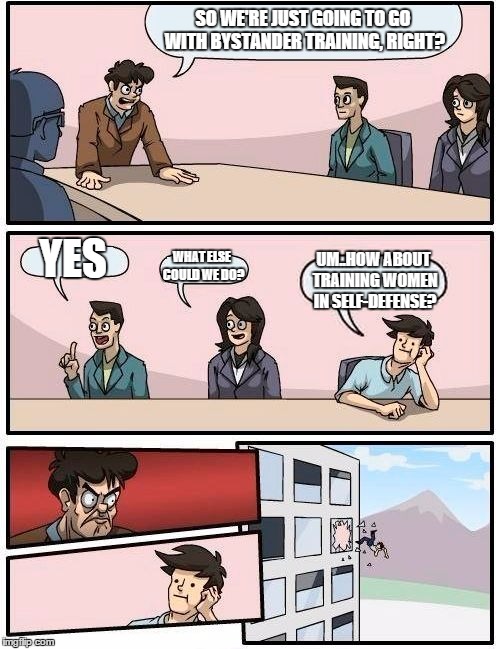
Eh hem, drumroll please…. Our major article is available here on the Univ of NC repository. By “major” we mean full-length academic article in a peer-reviewed scholarly journal, namely Trauma, Violence, and Abuse. (Well, ok, by “major” we also mean that it took us a really long time and we kinda hope that Joe B. invites us to the White House to discuss our ideas with his Task Force.) In this article, we trace the meaning of “prevention” in the sexual assault prevention efforts on college campuses, and question why self-defense training is rarely a part of those efforts. Given that national attention, and new compliance mandates, have been heaped upon college campuses for their sexual assault problem, we think it’s a key time to review the scholarship on the efficacy of self-defense. Once you see all that in one place, it’s hard to accept people claiming that they don’t include self-defense in their anti-sexual assault agenda because we lack evidence for its effectiveness, or because it’s not “primary prevention”. Indeed, we argue that it is gender ideology, not a lack of evidence, that explains the tendency to exclude self-defense from our sexual assault prevention efforts. Moreover, we stress that self-defense is not secondary prevention but primary prevention as self-defense is a key protective factor in the public health model of rape prevention. And, because we’re all about solutions, our article ends with specific ways college campuses can incorporate self-defense into various sexual assault prevention efforts.
(Yet Another) Open Letter to the White House Task Force to Protect Students from Sexual Assault
Dear Members of the Task Force,
On September 17, 2015, you released a Resource Guide to assist college and university communities in their efforts to combat sexual assault on college campuses. It is an excellent review of what the Center for Disease Control and the White House Task Force have decided, prima facie, constitutes acceptable methods of preventing violence. Those include talking about healthy relationships, encouraging people to act as engaged and responsible bystanders, and shifting social norms around gender, sexuality and violence. And, when that it is all that you include in your definition of sexual violence prevention strategies, you rightly conclude that not much works.
You, and the CDC, and many other well-intentioned agencies and organizations, continue to systematically exclude self-defense training as a viable and acceptable method of sexual violence prevention, despite decades of evidence on the effectiveness of women’s self-defense in thwarting sexual assault, and despite the more recent evidence in the last ten years on the positive benefits of self-defense training, including the effectiveness of self-defense training in reducing future rates of sexual assault.
The data is available. The problem is your definition of what constitutes prevention.
Women are capable of engaging in powerful and effective resistance strategies, both physical and verbal, to thwart rape and sexual assault, and offering them the opportunities to learn and practice those skills via self-defense training is a method of primary prevention completely in line with the CDC’s stated definition, and entirely consistent with the strategies and methods they have chosen to include.
And yet you, and they, continue to exclude it.
There are many things about women’s use of and training in self-defense that people don’t like. It is not that it doesn’t work, because the data say it usually does. We can’t dismiss it outright as inconsistent with the definition and goals of “primary prevention”, because, as we have pointed out, self-defense IS primary prevention.
So we’re left with facing the ways that women’s training to defend themselves shifts norms around gender, sexuality, and violence. That is does so, we are left to conclude, is why people don’t like it. It’s much more compatible with current gender ideology to suggest women wait for some person or institution to save or protect them. Ironically, the Task Force also suggests we engage efforts to shift social norms around gender, sexuality and violence. Let’s do that. If you’re not going to, then may we suggest the following revision to your statements:
How to Prevent Sexual Violence on Campus:
• Engage in Primary Prevention (BUT PUT SELF-DEFENSE IN THE CATEGORY WITH VICTIM SERVICES, REPORTING OFFENDERS, AND LEGAL COMPLIANCE PROCEDURES)
• Train Bystanders to Intervene to Stop an Assault on Someone Else (JUST DON’T LET WOMEN KNOW THAT THEY COULD SERVE AS THEIR OWN INTERVENING BYSTANDERS!)
• Use Evidence-Based Methods for Sexual Assault Prevention (EXCEPT THE EVIDENCE THAT SELF-DEFENSE USUALLY WORKS!)
• Shift Social Norms around Gender, Sexuality and Violence (BUT NOT TOO MUCH! AFTER ALL, WE DON’T WANT WOMEN TO CONSIDER THEMSELVES ENTITLED TO THEIR BODILY BOUNDARIES!)
On January 22, 2014, President Obama said:
If you’ve really got the backs of sexual assault survivors, and truly want to support effective methods of sexual assault prevention, you cannot continue to ignore self-defense training as an important, effective, and valid method. Provide the resources and support for women to be their own bystanders.
Protest the “Asking for It” Rhetoric by Dissing Self-Defense?
Kate Harding is advertising her new book, Asking for It: The Alarming Rise of Rape Culture–and What We Can Do about It (2015, Da Capo Lifelong Books), with an excerpt in The Guardian.
This makes us feel really old. First, rape culture has just risen? As if. Second, the hopeful subtitle “and what we can do about it” is not going where we hoped it might. We’ve been through this so many times that we should have predicted that Harding would include self-defense in her lament about all the disempowering things women do, but shouldn’t have to, in order to avoid or otherwise protect themselves from rape. Harding states in The Guardian:
“There’s something wrong with expecting women to remember that they should always go for the groin, or the eyes, or the armpit, or the upper thigh, or the first two fingers (I am not making any of these up), and that it only takes five pounds of pressure to rip off a human ear, and if you hit someone’s nose with the palm of your hand and push up just right, you can drive the bone into their brain and kill them.”
It’s too bad Harding does not say what that “something” is that is wrong with self-defense. Maybe it’s that women are too delicate and pure to envision themselves doing such violent things. Or perhaps it’s that women should not really be that vigilant about standing up for themselves. Or maybe it’s that women shouldn’t have to worry their pretty little heads about the violence that is out there in the world. After all, it’s hard for ladies to remember so many things (like when Barbie reminded us, back in the 90s, that math is hard). Men are actually victims of violence more often than women are; would Harding say there is “something wrong” with men needing to know how to handle (de-escalate, resist, thwart, or otherwise survive) a violent encounter?
Harding goes on to state:
“By the time we finish high school, our brains are already filled with such rape-proofing basics as the appropriate skirt length for discouraging violent attacks (long); the number of alcohol units that can be consumed before one is thought to have invited sexual assault (one, tops); a list of acceptable neighborhoods to visit alone in daylight; another of acceptable neighborhoods to visit alone after dark (just kidding – there are none); and a set of rudimentary self-defense moves (“Solar plexus! Solar plexus!”).”
For Harding, encouraging women to learn any self-defense is akin to telling them to wear a burka–victim-blaming nonsense that restricts women’s freedom, blames women for rape, and, regardless of its effectiveness, diverts our attention from getting men not to rape:
“This ubiquitous idea that, by controlling our behavior, appearance and whereabouts, we can keep ourselves from being raped does nothing to help women (let alone potential victims who aren’t women). It merely takes the onus off the rest of society to seriously consider what we can all do to prevent sexual violence.”
We wish Harding would talk to women who teach and take self-defense classes. If she did, she would learn that making women aware of their rights to defend themselves, and offering them training in self-defense skills, empowers women to move freely about the world and make the choices that are best for them – choices like how short to wear their skirts, or what beverages they consume, or which neighborhoods they frequent, or yes, whether to go for the groin or the solar plexus if someone is trying to assault or rape them. Even though she published with a nonacademic press that is geared toward attracting a wide audience, we wish Harding would have done her research. If she had, she would know that, unlike much rape-avoidance advice women hear, self-defense expands women’s freedom and, moreover, really does challenge the rape culture.
 See Jane Fight Back
Recent Comments