An Open Letter to Dan Turner, father of convicted rapist Brock Turner: Here’s What’s Unfortunate
Dear Mr. Turner,
Your son, Brock Turner, is a convicted rapist. The facts of his crime are not in dispute: Brock sexually assaulted an intoxicated woman behind a dumpster. He was caught by two men who realized that a crime was taking place and who thus not only intervened but held your son until police arrived to take him into custody.
Despite your assertion to the contrary, Brock Turner was, in fact, violent to another human being on January 17, 2015. He was convicted of 3 felonies. Your response? To hold up as a role model for other college students. You are quoted in multiple media outlets saying that “…having people like Brock educate others on college campuses is how society can begin to break the cycle of binge drinking and its unfortunate results.”
Rape is not an “unfortunate result” of your son, Brock Turner, having one beer too many, Mr. Turner. Rape is the crime committed by your son against another person, who has painfully and eloquently described the lasting impact of your son’s brutal attack. Your son, Brock Turner, is a convicted rapist who violently attacked another human being, and unless that is what he is going to say to the college students you claim he can “educate”, what they will learn is that sexual violence against women is simply an unfortunate result of boys-being-boys and having a good time at a party. Yes, Brock was drunk. But his victim was unconscious. Unconscious people cannot consent to sex, and that is rape.
What would his message be, Mr. Turner? “My dad said I shouldn’t have gotten jail time!”? “Judge Aaron Persky felt bad sending someone like me to jail <sad emoji>”? “What you call rape, I call sexual promiscuity – but you know what those co-eds are like…”?
Here’s what is truly unfortunate, Mr. Turner: your son is in good company. Recent studies have demonstrated that as many as one third of college men report that they would rape a woman – or force a woman to have sexual intercourse against her will (they are a little unclear sometimes that those are the same thing) if they could do so without consequences. And male college athletes are right there in the mix.
Dan Turner, you, and your enthusiastic endorsement of your son’s right to rape, are the best evidence we could offer that the only thing to be learned from this is that we need a radical response to rape and sexual assault. We need to punish offenders and teach women and girls to defend themselves, both of which send a strong cultural message – that rape and sexual assault will not be tolerated, and that the consequences to the rapists will be severe. Self-defense training might not have helped the woman your son Brock raped, but we know it helps others both defend themselves AND intervene to help others, like the two young men who intervened while Brock was raping that young woman. It reminds women and men that women are entitled to their boundaries – a cultural shift that is, as your statements and the statements of others show, is sorely needed on campus today.
And yes, we need to change people’s attitudes, but, as you so eloquently demonstrate, the goal is not for all of us to see things the way you and your son and Judge Persky do. It’s to get people on board with the fact that rape is a crime, that justice for rape victims should be swift and consequences to rapists severe, that 20 minutes lasts a lifetime.
It’s not just unfortunate that you and Brock Turner and Judge Persky don’t get that, Dan Turner. It’s criminal.
Jill Cermele and Martha McCaughey
CDC Frames Changing Interactions Between Two People as a Prevention Strategy (but not for Sexual Assault)
OPEN LETTER TO THE CDC
Dear Center for Disease Control and Prevention,
Your recently released report on fatal abusive head trauma in children under 5 embraces a range of prevention strategies (your words, not ours) to combat a type of violence that parents or caregivers perpetrate against children. You remind us of the need for collecting good data, for shifting cultural norms around parenting, and for strengthening economic support for families through a variety of policy changes.
And then, CDC (may we call you CDC?), you say this:
“There is growing evidence that child maltreatment prevention strategies, such as those that change interactions, including those between parents and children, parents and other caregivers, and parents and health care providers are effective interventions (7). [The CDC] resource [is]…based on decades of research about effectively promoting positive parenting and preventing child maltreatment, using various approaches, including videos and interactive practice exercises, to help caregivers build healthy relationships with their children aged >3 years.” [emphasis ours].
We wholeheartedly agree – using interactive practice exercises that change interactions between people is an effective prevention strategy supported by decades of research.
Not just in the prevention of child maltreatment. Also in the prevention of sexual assault.
But you should know this, CDC. We’ve told you before. But instead you continue to frame self-defense as a “risk-reduction” strategy instead of as primary prevention.
On the bright side, your Sexual Violence Prevention Package (pages 19-22) lists empowerment-based self-defense among the skills-building strategies we should be teaching.
We applaud your recognition that, with respect to abusive head trauma in children, prevention is a multi-faceted approach, and that changing interactions between caregivers and children is an important aspect of that prevention model.
Let’s have those same standards apply to preventing sexual assault, and recognize that empowerment self-defense training IS part of a comprehensive prevention model; it creates population-level change by challenging rape myths and the dynamics around gender, in addition to teaching people a range of verbal and physical personal safety strategies to prevent sexual assault.
In solidarity,
Jill Cermele and Martha McCaughey

You Won’t Find Self-Defense Mentioned Here Either
Last week all the employees at my workplace were sent an email offering us a service to help us achieve work-life balance. No, it was not a raise, a massage, a paid week off, or a nanny. It was the ability to subscribe to ComPsych Corporation’s GuidanceResources Online Web site. Once you register, you are promised access to useful information, news, interactive materials, and services in your area.
By the company’s own description, “GuidanceResources Online is home to hundreds of articles, assessment tools and multimedia presentations on a wide variety of topics.”
Need a carpenter? On there. Need to find childcare? There. Tips on coming out a work? Yep. Advice on why monogamy is the best and why cheating is a bad idea (and, let’s face it, will make you a less productive employee)? Indeed. It’s as if Oprah had invented this herself!
But no, there is no advice on having a successful and happy polyamorous relationship.
Nor will you find information on self-defense. Through the search function no information on “sexual assault” comes up. But searching on “rape” several articles come up. Here they are.
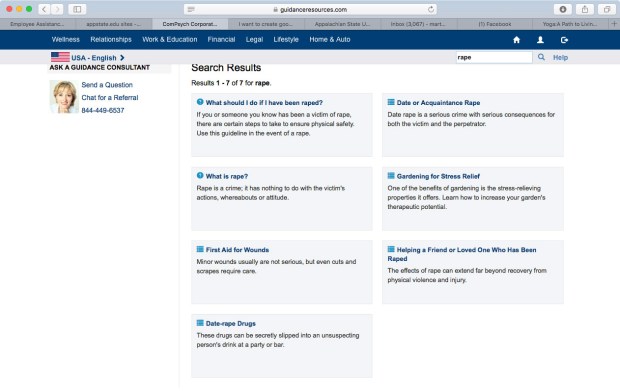
Gardening? Seriously? And take care of cuts and scrapes but no need for a rape kit…. Of course self-defense training is not listed as one of the prevention efforts to engage in. Let’s quote in full the “Date or Acquaintance Rape” page:
Date or Acquaintance Rape
Date rape is a violent crime with serious consequences for both the victim and the perpetrator. Continuing to force sexual activity after being told no is considered rape and is punishable under the law.
Date rape can be especially hard for victims to deal with because it is often committed by a friend or acquaintance. Like other forms of rape, date rape is not about sex; it is an act of violence in which power and control are the underlying motivating factors. Counseling through a rape crisis center can help victims cope with the trauma and make informed decisions about their legal options.
Nobody ever thinks they will be in a situation where date or acquaintance rape could occur, but these tragic events happen to women every day. The following tips can help you avoid many dangerous situations:
- Provide your own transportation to and from your date. This asserts your independence and makes it easier to get away from an unpleasant or dangerous situation. Carry cab fare and a cell phone when possible.
- Refrain from drinking alcohol or taking drugs. Be especially wary of situations in which games or contests encourage drinking lots of alcohol in a short time. Alcohol and drugs often are present in date-rape situations. For the victim, use of these substances can impair judgment, memory and ability to sense an unsafe situation developing. Some date rapes occur after the victim has passed out from too much alcohol. Drugs and alcohol also may cause the perpetrator to become more sexually aggressive.
- Be extra cautious about what you consume. The increased use of date-rape drugs like Rohypnol poses a real danger to your safety. Avoid beverages that are not sealed or were not prepared in your sight.
- Be aware of your surroundings and avoid isolated areas. Remove yourself from the situation immediately if you are even the least bit uncomfortable.
- Examine your feelings about sex and establish your limits before you are in a sexual situation. Then communicate those limits clearly and forcefully.
- Do not give mixed messages; be clear. Say “yes” when you mean yes and say “no” when you mean no. If you have trouble doing this, counseling or assertiveness training can help.
- Do not worry about seeming impolite or causing a scene if you feel that your safety is threatened.
- Be aware of specific situations in which you do not feel relaxed or in control. Avoid attending or staying late at parties where men greatly outnumber women, especially when drinking is involved. If you do not feel safe leave the event early.
- Stick to dates in public places like movie theatres or restaurants until you get to know and trust your date. Try double dates or group dates until you feel comfortable on a solo date.
- Think twice before inviting someone home. Most date rapes occur in the victim’s own residence. Take time to develop a trusting relationship before going to your date’s house.
- Trust your instincts. Many victims report that they sensed things were not quite right but were embarrassed to act on their suspicions until it was too late.
If you have been or suspect you may have been a victim of date or acquaintance rape:
- Seek medical attention first. Go to your hospital emergency room or school health center to be examined. Be aware that showering can destroy evidence that you could use later to legally establish the identity of the perpetrator, should you decide to press charges.
- Consider talking to the rape unit at your local or campus police. Take a friend along for extra support.
- If you are not ready to pursue the matter legally, call a local rape hotline, and tell them about your experience. The Rape Abuse and Incest National Network (RAINN) runs a National Sexual Assault Hotline: (800) 656-HOPE or www.rainn.org.
- Consider ongoing counseling to help you deal with the long-term effects of this trauma.
- RAINN: http://centers.rainn.org
- National Council of Women’s Organizations: www.womensorganizations.org
©2014 ComPsych ® Corporation. All rights reserved. This information is for educational purposes only. It is always important to consult with the appropriate professional on financial, medical, legal, behavioral or other issues. As you read this information, it is your responsibility to make sure that the facts and ideas apply to your situation.
Upstream vs. Downstream
It’s amazing what we learn when we read outside our field. An article by William Scott (University of Bath, United Kingdom), “Public Understanding of Sustainable Development: Some Implications for Education,” published in the International Journal of Environmental & Science Education (2015, 10:2: 235-246), reveals that those engaged with sustainable development efforts face many of the challenges those of us doing sexual assault prevention face.
Specifically, Scott and his colleagues feel that they’ve done too much “downstream remedial” work (measures that deal with the consequences of harm) and not enough “upstream prevention” work (interventions to address the underlying causes of problems). Sound familiar?
Scott describes an N.E.F. report, which “argues for prevention, and says that bottom-up prevention is best, with people and organisations becoming more resilient: building up their own immune systems, both literally and metaphorically, so that they become less susceptible to harm, changing attitudes and capabilities so that they are better able to take positive actions themselves.”
This is very much our approach with empowerment-based self-defense training. But just as with the other SD (sustainable development), with SD (self-defense) we find rather dramatic disagreement over whether it’s downstream remedial or upstream prevention. In fact, many feminists who are strongly interested in dismantling our rape culture do not emphasize SD on the grounds that it’s downstream remedial. We have long argued that SD can best be understood as upstream preventative.
According to Scott, that logic of prevention in sustainability education contradicts the “rescue principle” of so much philanthropy, charity, and health care. Rescuing people downstream can feel good but does not do the upstream prevention we need done. In that same way, bystander intervention programs, counseling services for victims, and training people to emphasize reporting on campus or in the workplace embody the rescue principle in rape prevention and education work.
Interestingly, Scott points out that many individuals and families are making efforts for sustainability, for instance by setting up a solar PV system. At the same time, only government can bring about macro-level change through “policy shifts, regulatory change, economic levers, and investment activity, for example.”
We, too, want macro-level change to the rape culture, and yet we also think individuals and groups practicing empowerment-based self-defense move us beyond the rescue principle and serves the effort of upstream prevention. Training women in self-defense may not be like taking the carbon out of electricity production, but it is at least as compelling as setting up your own solar PV system. We must do both for true prevention and social change. Self-defense training builds women up so that they are less susceptible to harm. Surely there’s no harm in that, other than to the rape culture.
Barbie Can Be Curvy, But Can She Fight?
Open Letter to Mattel:
Wow, Mattel, it like, took you long enough. Nothing like dwindling sales to respond finally to the zillions of critiques that Barbie was too skinny and buxom for girls to play with and still have a future free of eating disorders, and for their feminist mothers to agree to purchase.
But, hey, at least it finally happened. 
And so we’re wondering how long it will take you to allow Barbie into the 21st Century with skills like karate, axe kicks, and verbal self-defense.
I mean, Barbie’s been talking since the 1990s. She’s been using social media for a decade. And she’s been sexual for–let’s face it–over 50 years. I mean, come on, “Sweater Girl” Barbie was not really about knitting.
Mattel, you ask us to imagine the possibilities – professor, veterinarian, coach, executive, world traveler. How about a Barbie who can set and assert her own boundaries, who can talk to Ken – or Skipper – about what she wants in an intimate partner, who can say “yes” when she wants something and “no” when she doesn’t, and who has the verbal and physical skills to stop someone from trying to hurt her or assault her or rape her?
Barbie can be the object of our consumerist one-percenter aspirations, or Barbie can become the toy through which girls can imagine a future in which they can be smart, strong, successful, and safe. If our girls can imagine Barbie saying “No!”, executing an eye strike, kneeing Ken in his groin, just think what they can imagine for themselves.
With love and the certainty that the beach really is the place for summer,
Martha & Jill
Breaking news: SJFB recants its stance on self-defense
We here at See Jane Fights Back would like to issue a heartfelt apology to our readers. (“Sorry! Sorry, sorry, sorry…) We have thought, we have pondered, we have watched the presidential debates, and now, finally, we get it – women are neither capable of resisting violence nor able to advocate for themselves.
We thought we were, you know? There’s that data – ALL that data – that says self-defense works, that training women in self-defense can reduce the risk of sexual assault by up to 40%, that there are added benefits in areas like self-esteem, self-confidence, empowerment, and personal freedom.
But those are just facts, and when people hold those facts up against how they feel, what they believe to be true, it doesn’t always add up. Like how some people don’t believe in global warming. Or evolution. Or equality. Or racism or sexism or homophobia or…well, you get the idea, right?
So what happens, when the facts conflict with our beliefs and behaviors? We get cognitive dissonance, and that just feels…well, uncomfortable. And who wants to feel uncomfortable? So while we COULD adjust our beliefs and behaviors, and acknowledge that 1) violence against women and girls is a global public health crisis, and 2) gendered notions of vulnerability and strength do not solve that that crisis, AND 3) acknowledging effective resistance and offering self-defense training are two important ways to address that crisis, that’s just so HARD. Like Barbie said math was.
And we don’t like to do things that are hard, do we? It’s just easier to accept the status quo, to believe violence against women and girls is inevitable, to wait for the knights in shining armor (“Yoo hoo! Over here!”) to come save us.
So data be damned. We’ll just go with what makes us comfortable. Or more accurately, what makes lots and lots of other people comfortable. Because women being powerful and self-determined and safe is so….so….what’s the word? Unattractive? Unreasonable? Discomforting?
Oh wait – we’ve got it. Reasonable. It’s just so reasonable.
Happy April Fools Day.
Verbal Self-Defense Training
Women’s self-defense advocates must remind people often that self-defense is not simply learning how to punch and kick. It’s about learning a more entitled, assertive way of being in the world. That attitudinal shift is remarkable, as Olga Kreimer notes in The Washington Post. Being aware of your surroundings and speaking up assertively make powerful impressions on people.
And given the way our culture has trained women to put others’ needs and feelings before their own, women’s second-class status is often embodied in the way we dress, sit, stand, walk, and talk. It’s no surprise, then, that women in self-defense training must practice speaking differently.
And it is worth practicing; here, we imagine how famous quotes might have been spoken by a woman trained in our sexist culture vs. how they were spoken by a more entitled, authoritative person:
Mr. Gorbechev, excuse me but I’m wondering what it’d be like if you were to consider maybe taking that wall down?
Mr. Gorbechev, tear down that wall! -Ronald Reagan
I know you’re trying and everything, but it kind of needs to be done, so could you just try to do it? Thanks… When it comes down to it I’m thinking that, in the end, you will either have done it or not, you know?
Do or do not, there is no try. -Yoda
I’m so drunk, and I’m sure you’re really attractive although I don’t really know because beauty is pretty much in the eye of the beholder anyway, but how about I let you know in the morning when I’m sober?
I may be drunk, Miss, but in the morning I will be sober and you will still be ugly. -Winston Churchill
Let’s try and see if we can coordinate this and like, live together, you know what I mean? Wouldn’t that be so much better than perishing together? I mean, how foolish would that be?
We must learn to live together as brothers or perish together as fools. -Martin Luther King, Jr.
Try to live the kind of life that will model how you want others to live, because if you want them to change you’ve got to show you’re willing to change, too, otherwise that would be hypocritical and nobody likes a hypocrite, and it’s important to be liked.
You must be the change you wish to see in the world. – Mahatma Gandhi
I really want you to like me, but I’m not entirely sure that this is the best way to achieve something since my wanting you to like me could lead me to compromise on something, and ultimately you might not like that.
If you set out to be liked, you would be prepared to compromise on anything at any time, and you would achieve nothing. – Margaret Thatcher
Um, that’s my daughter, so could you please leave her alone?
Not my daughter, you bitch! – Molly Weasley
I know things can be really hard, and I’m so, so, sorry about that, and I hate to give you more to do, but maybe you want to do something…?
Life’s a bitch. You’ve got to go out and kick some ass. – Maya Angelou
What’s Wrong with the CDC’s Public Health Model for Rape Prevention
Also on the Gender & Society blog (copyright 2016 Jill Cermele and Martha McCaughey)
The 2014 White House Task Force on Sexual Assault on College Campuses has mandated that in order to continue to receive federal funding, colleges and universities must step up their game, including providing rape prevention education. The 2014 “Not Alone” report outlines the Center for Disease Control and Prevention’s (CDC) public health model of sexual assault prevention, and reiterates the need for evidenced-based programming to combat rape and sexual assault. The CDC’s public health model defines the terms and levels of prevention, and articulates what “counts” as primary prevention – namely, bystander intervention training and psychoeducation to shift rape-supportive attitudes. As we describe in detail elsewhere (see McCaughey & Cermele, 2015), despite the overwhelming evidence that self-defense (training and enacting it) works both to stop rape and to shift rape-supportive attitudes, the CDC does not discuss or recommend self-defense training in its public health model.
On the surface, the omission of self-defense training from the category of primary prevention is perplexing, considering the CDC’s own definition. Primary prevention is defined as thwarting violence before it happens, while secondary prevention includes strategies and responses that immediately follow victimization, such as counseling or medical care, to address the short-term effects. The CDC has consistently and openly argued that while teaching (often male) bystanders to intervene in and thwart sexual assault is an established primary prevention tactic, teaching women to intervene in and thwart sexual assault targeted against themselves is not.
This stance is flawed for two main reasons. First, both self-defense training and bystander intervention training target sexual violence at the same point in time – when a sexual assault is imminent or in progress. So while both meet the criteria for primary prevention, they differ on one important dimension: who is encouraged to intervene. Bystander training requires the presence of a (presumably) benevolent and engaged third party to thwart rape, contributing to the erroneous belief that the woman targeted for sexual violence cannot, or should not, intervene on her own behalf.
Self-defense training, on the other hand, disrupts the script of sexual violence by offering women a range of verbal and physical strategies to thwart rape, which, although it can include soliciting bystander intervention, does not require the presence of a bystander in order to prevent assault. Given that both methods of rape prevention education target sexual violence at the same point in time, with the same goal and even potentially similar methods, it stands to reason that they must be in the same category – they are either both primary prevention, or neither are.
Second, only one of these meets the CDC’s second criteria, that rape prevention education be demonstrably effective – and that is self-defense training. The data are clear—and reviewed in our article (McCaughey & Cermele, 2015)—that self-defense is effective in thwarting sexual assault. In addition, numerous empirical studies have documented that self-defense training is what the CDC calls a protective factor, and that women who have taken self-defense training are at less risk for sexual assault than those who have not, reducing risk of sexual assault by as much as 40%. Furthermore, self-defense training creates positive behavior and attitude change, including feelings of empowerment in women. Finally, women’s participation in self-defense training and the enactment of effective resistance strategies directly challenge the attitudes that permeate rape culture: that the safety and integrity of women’s bodies exists at the whim of men’s bodies. Women who learn to defend themselves learn to take themselves and their safety seriously in realistic ways, rather than simply following an unsubstantiated list of “don’ts” – don’t wear this, don’t go there, don’t be alone. Instead, they assess situations better than they did before their training, are more likely to identify situations that could be dangerous, and have the skills to respond if necessary.
We also reviewed the data on bystander intervention training (see McCaughey & Cermele, 2015), which are much less promising. There is some research demonstrating that participants in bystander intervention rape prevention education reported positive changes in attitudes and increased intent to intervene or increased self-reports of intervention. However, there is as yet no empirical data to suggest that bystander intervention programs are effective in actually thwarting rape and sexual assault. And yet, the CDC maintains its stance that bystander intervention training meets the criteria for primary prevention, and self-defense training does not.
This cannot continue. By the CDC’s own criteria, training women in self-defense is a demonstrably effective primary-prevention strategy in preventing rape and sexual assault, and is entirely consistent with the goals of a public health model in combatting the crisis of sexual assault on college campuses. At a time when so many organizations and task forces are looking to the CDC’s public health model for combating sexual assault, the CDC must begin to pay attention to the data and acknowledge women’s capacity for and right to resist sexual assault. Self-defense training belongs at the forefront of their recommendations for sexual assault prevention on college campuses.
Citation
McCaughey, M., & Cermele, J. (2015). Changing the hidden curriculum of campus rape prevention and education: Women’s self-defense as a key protective factor for a public health model of prevention. Trauma, Violence, and Abuse, online pre-print, 1-16. DOI: 10.1177/1524838015611674 tva.sagepub.com
 See Jane Fight Back
Recent Comments