Guest Post: Campus Rape Crisis: What’s Missing From The White House Sexual Violence Plan
Clearly, a wide network of self-defense advocates are as incensed as we are that the White House Task Force recommendations failed to include self-defense training. Thank you, Boston IMPACT director Meg Stone for a thoughtful, well-written piece! Best line: “The most important characteristic of effective self-defense training is that it makes clear that the responsibility for sexual assault is the perpetrator’s. ”:
Campus Rape Crisis: What’s Missing From The White House Sexual Violence Plan
Jogging U.S. Marshal Kicks Man in the Crotch…and So Can You.
In the last few days we have seen a lot of press about the woman who fought back against her assailant and held him captive until the police arrived. It’s a great story with a great ending. The woman was out jogging when a man who, according to the news media, first identified himself as “Johnson” (we laughed out loud at that one), grabbed her ass and pulled her shorts down. She yelled at him to stop, identifying herself as a marshal, yelled to those nearby to call 911, and took off after him. She apparently then cornered him, and when he charged her, she kicked him in…well, in his Johnson. (Probably actually under and behind his Johnson, but either way.)
It’s a great story. A great, great, story, and we are delighted the media has reported it as widely as it has. One important point is missing, though, and we want to bring it up.
You don’t have to be a U.S. Marshal to fight back.
We love that she’s a U.S. Marshal for all kinds of reasons, but that title and job training are not required to kick someone in the groin, or fight back in all the other ways we know women and girls fight back all the time. Sometimes we get to hear those stories when they make the news – the 10-year-old girl who fought off a sex offender, the teenager who fought off two assailants on her way to band practice, the woman in her 30s who fought off an attacker in the laundry room of her building, the self-described “little old lady” who fought off an attacker in a parking lot. Most of the time, we don’t. But they happen all the time. And we want to know all the stories.
Perhaps if more of women’s self-defense success stories were shared, women would have more confidence about their abilities in these situations — and men would have less.
An Open Letter to the NPR Weekend Edition Staff and the Parents of College Students You Misled
Dear NPR Weekend Edition Staff and the Parents of College Students You Misled:
The August 24 program “Weekend Edition” produced a story on how some universities are “tackling sexual assault before parties start”, which underscores how important it is for parents, as well as colleges and universities, to prepare students in advance, and to remind them of the risk while offering them strategies to reduce it. This broadcast featured a clip of a conversation between a father of an incoming University of New Hampshire student, who is a doctor, and his daughter, “Kelly”. When Kelly asks her father specifically for advice (“What should I know about consent and assault and rape?”), Dad offers Kelly the following advice:
- Anticipate a situation before you get into it
- Always travel with friends
- Have a planned list of activities, night and day
- Avoid isolation
- Avoid substances
Kelly feels better, and Kelly’s Dad, who is clearly educated, informed, and appropriately concerned about his daughter’s safety and well-being, has done his job. And yet, what has she been told, really? Don’t ever be alone, don’t ever drink or use drugs, and keep yourself on a preset busy schedule. In other (vague) words, avoid, curtail, limit, distract, and then hope for the best. She might as well live at home and take all her courses online.
The take-home message of that list of rape avoidance strategies — inadvertently offered, perhaps, but communicated nonetheless — is that once danger is imminent, the outcome is a given. If one’s avoidance measures fail, there is no advice provided, implying that women do not have the option of fighting back.
And yet research has shown that girls and women are capable of safely and effectively resisting rape and sexual assault. Self-defense training is one critical way to teach, and allow for the practice of, active and clear strategies for things you can say and do in a potentially dangerous situation, where someone is trying to rape or assault you. And the research tells us that these strategies make women feel safer, make them more empowered to set and assert their boundaries in a range of situations – including social and dating situations – and can effectively prevent an assault or a rape from occurring.
So NPR and parents, please have these conversations, and please include not only a guy’s legal obligation not to attack but a gal’s legal right to defend herself. Here’s our script for daughters:
If someone tries to rape or assault you, one thing you need to know is that you have the right to protect yourself – verbally or physically. You have the right to tell someone that what they are saying to you, how they are touching you, is not what you want, is not okay, is a crime; you have the right to yell and scream and call for help and make a scene to attract the attention of someone who might be able to help you. And you also have the right to physically resist – by pushing, shoving, hitting, kicking, with any part of your body that you can use – hands, elbows, hips, knees, feet – and against any part of their body – testicles, face, abdomen, arms, legs. And, you need to know these are all things you can do, and have the right to do, but that if you are in danger, we trust you to make the best decision for yourself that is going to keep you feeling as safe in the moment as possible. And that means that while we want you to know that it is okay for you to do these things, it doesn’t mean you have to or you should. You do what’s best for you, and we will love and trust and support you, no matter what.
Not that anyone asked, but here’s our script for sons:
If you want to do something physically intimate with someone, tell them and ask them. If the person you’re with has been drinking or using drugs, consider them incapable of offering meaningful consent and move on. If the person is reasonably sober and makes it explicitly clear that the desires are mutual, great. Do not assume you can pick up signals or hints. Do not ever attempt to impose yourself or your will onto another person. It’s neither sexy nor legal. Don’t treat anyone as an “easy lay.” If you don’t understand these principles, you just might get your ass kicked.
That’s the way to tackle sexual assault before the party starts.
Sincerely,
Jill Cermele and Martha McCaughey
“Clear Communication” Must Include Self-Defense

If you’ve been following the hilarious Tumblr site, “Confused Cats Against Feminism,” you’ll have seen this dog who says “all cats love being chased, you can just tell.” This joke is funny precisely because we know that what the dog believes is wrong, and it mocks the attitude through which a man might dismiss the feminist insistence that women actually have sexual boundaries. If a guy thinks — no, knows — that, deep down, a woman “wants it” and is certain that he “can just tell,” then our rape prevention strategy of telling people to “communicate clearly” is not enough.
Given what a common problem date, acquaintance, and party rape is on college campuses, students are routinely told to “communicate clearly” so that their dates aren’t left to read facial expressions and eye movements. Of course, this presumes that a guy is sexually assaulting out of just “not realizing”, or being insensitive to, the fact that the woman doesn’t want the same thing he wants, and that if he had only known he’d have backed off immediately. While this might be true in some instances, we know this is not necessarily the case, as evidenced by victims’ – and some perpetrators’ – reports that saying “NO” does not always stop an assailant.
Our culture teaches, and therefore some guys learn, that guys’ opinions and ways of defining situations are more important than those of the female persuasion. To take a hypothetical example, if a guy’s buddies (and his men’s magazines, and most TV shows, movies, blogs, and news reports) all convey that when a woman is eating chocolate, she gets so excited that she’ll want sex with whomever is in her company, then this guy will be reading, understanding, and even thinking empathically about this chocolate-consuming woman (or at least his idea of women), as wanting to have sex with him.
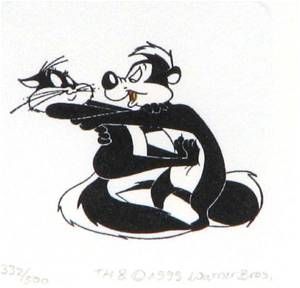
The 1960s Warner Brothers Pepé Le Pew cartoon humorously illustrates this point. In that cartoon, a male skunk chances upon a black female cat who has unfortunately had a stripe of white paint spilled across her back. Since we know she’s a cat, we understand that she finds the skunk repugnant. Pepé Le Pew is comically clueless as he chases the nonverbal kitty and repeatedly attempts to capture her. At every turn, the skunk interprets every act of resistance on the cat’s part as a further invitation to him to pursue her. When she attempts to run away from him, and when she resists him by hitting him over the head, he construes her as “flirting.” He concludes that “she wants to play hard to get” and that “she is shy” at other points when she shows what we know is opposition to him. At one point, the skunk expounds, “She thinks that by running away, she can make herself more attractive to me. How right she is!”
Now, in the world of cartoon skunks, we might assume that a female skunk would indeed desire Pepé le Pew, simply because she too is a skunk, and we recognize that Penelope does not want Pepé because she is really a cat. However, in the world of human beings, as Virginia Tech sociologist Neal King’s analysis reminds us, there is no category through which a guy can assume or presume a woman is sexually interested in him. Yet in a rape culture that constructs women as sexually available to men for the taking, a guy might arrogantly (mis)interpret any number of things – a woman’s race, social class status, college Greek house, academic status, level of attractiveness, gestures, and behaviors – as a desire for sex with him. But none of those things can, or should, provide a guy any assurance whatsoever of his desirability to a woman. Sadly, though, as Prof. King (p. 874) puts it, “[M]en can interpret anything that women do as signs of desire.”
Given the all-too-common tendency of guys interpreting, Pepé le Pew style, women’s behavior as signals of sexual interest, Dr. King concludes that no amount of telling men or women to communicate better will necessarily bring about sexual encounters that are truly respectful and consensual. If the problem is the default assumption, “She wants to have sex with me!”, then telling men and women to communicate more clearly won’t reduce the number of sexual assaults on dates and at parties. King (2003: 874) argues that the rape prevention strategy that emphasizes the victimization of women “may be the least constructive part of our project.” Further, he argues that affirming women’s vulnerability (as opposed to emphasizing their willingness and ability to resist rape) and encouraging men to know women more, and more deeply, are bound to backfire on us.
A good way to challenge men on their sense of certainty is to get them to question how they “know” what they “know” about women, to make them feel less certain than they may already feel.
Furthermore, if we teach women the techniques that allow them to back up their verbal communication with physical resistance, then we do two things: we give them the practical, in-the-moment tools to thwart a sexual assault, and we provide to men a series of behaviors and words far less likely to be (mis)interpreted as sexual interest. Teaching women to defend themselves, publicizing their ability widely, and pressing the point that women resist might just challenge men’s sense of sexual certainty.
Postscript: We regard it as no coincidence that Neal King has cats.
Miss Eliza Leslie’s Hookup Handbook for Ladies

Ladies have both a body and a mind. At times the indiscrete, sweating, aging, and sagging former seems to hold the latter hostage. And yet, on a nice sunny day when one is feeling good, one hardly feels challenged by her embodiment and a lady might find herself seeking the affections of a gentleman. Indeed, the practice of hooking up at parties or at the prompt of a text message is now universal.
A lady must therefore know how to proceed when under the sweet liberty of the primal pleasures of the body, especially because not all gentlemen will comport themselves with the propriety a well-mannered deportment demands.
Indeed, some gentlemen will make impertinent carnal requests—nay, demands—insisting that they are subject to an infirmity of the sort that prevents them from having a rational command over their bodies. A lady need not bear this malady on his behalf. For this man, regardless of fame or fortune or position on the football team, is a blockhead and you may simply explain that you will not engage in this behavior and expect him to stop. Indeed, a lady ought to shout “STOP” as loudly as she likes to emphasize that her desire had been a product of his illusions.
However, ladies should note that only some gentlemen will atone for their offense at this point, while others will stubbornly persist in their attempt for carnal knowledge of her.
When in the company of such affronting men the usual rules of propriety and feminine manners must be dropped and a lady should not hesitate to visit on the gentleman a violent change of fortune.
For example, a lady should know that the testicles of the gentleman (and it should be noted that once the aforementioned gentleman has proceeded beyond a “stop”, we are using the word “gentleman” with a deliberate sense of irony) house a significant number of sensory nerve endings, and lack the protection of bone, muscle, and fat. Therefore, a lady should know that a squeeze, twist, pull or slap to this area of the body, which the Creator has so conveniently located outside the body, effectively communicates the “STOP” which the gentleman may have had the arrogance or entitlement to ignore. In fact, it seems likely that their location outside of the body is designed to serve just this purpose – the conveniently located reminder – nay, warning – to gentlemen that “STOP” means “STOP”, and that “NO” means “NO”. Therefore, far from needing to worry about importuning this gentleman, a lady demonstrates her reverence for herself when she engages in this vehement, but necessary, rebuff.
Upon such action, the gentleman in question will likely drop to his knees; tears are likely to form in his eyes, and his skin may change in color in alarming ways. The gentleman may even find himself unable to move for some time without regurgitating the contents of his stomach. A lady need not concern herself with any of these responses, nor should she remain in the situation to observe or assess the situation at hand. A lady has better things to do than to dally with gentlemen of this ilk, and should ring 9-1-1 straight away.
By Martha McCaughey and Jill Cermele, inspired the 1853 “The Ladies’ Guide to True Politeness and Perfect Manners, or Miss Leslie’s Behavior Book, An Excerpt” by Eliza Leslie (author of “Mr. and Mrs. Woodbridge”), published in Selections from Eliza Leslie, edited by Etta M. Madden, Lincoln: University of Nebraska Press, 2011.
Self-Defense Can Work Well for Trauma Survivors
When we advocate women’s self-defense training, we often hear worries about the possible victim-blaming that is implied (“it will only make victims feel bad for not having defended themselves” and “it will only make people expect women to fight back in order to make a legitimate claim in a court of law”). We also hear related concerns about survivors of interpersonal violence. Won’t they feel bad for not having “successfully” defended themselves? Won’t they blame themselves for the attack they suffered? Will they be too traumatized to go through self-defense training?
Survivors are not necessarily ready for self-defense training, but some are. In fact, some survivors are even referred by a therapist to self-defense training because it can be helpful for reclaiming their power and sense of safety. Of course, for these reasons self-defense classes must be taught by well trained, feminist instructors who are sensitive to the many issues around gendered violence that can emerge when training women how to practice self-defense techniques. In the 2014 Special Issue of Violence Against Women on self-defense against sexual assault, Gianine Rosenblum and Lynn Taska outline the elements of self-defense training specifically for trauma survivors. The self-defense curriculum they helped develop is based in research on trauma and its treatment. In a class like this, a therapeutic teaching team works to understand each student’s needs, triggers, and window of tolerance. Students also have the option of requesting custom scenarios to (re)enact past events or trigger experiences, providing an opportunity to re-script the event or experience. In these self-defense classes, trauma survivors who are ready to enter self-defense training can experience therapeutic benefits such as the internalization of new emotional and physical resources.
Self-defense training is not just for the strong, the young, or the unscarred among us. And above all, self-defense need not blame past or future victims. Its aim is to empower us to challenge the rape culture that we live in, and the rape culture that lives in us.
Announcement and Essay from Amy Jones, coordinator of Peaceworks
“My Dream: Self-Defense Scholars and Instructors Working Together” by Amy Jones
http://impactchicago.blogspot.com/2014/06/my-dream-self-defense-scholars-and.html
Falling Short: The White House Task Force to Protect Students from Sexual Assault
Falling Short: The White House Task Force to Protect Students from Sexual Assault
From our colleague, Dr. Martha Thompson, Professor Emeritus at Northeastern Illinois University:
{ My Vagina Has a Dream }
Each year around Valentine’s Day hundreds of college campuses across the country put on benefit productions of The Vagina Monologues, Eve Ensler’s famous play about our. . . . ahem.
The Vagina Monologues has become the Lion King of feminism. It is performed to large audiences on campus after campus. The show’s popularity also underpins the organizational success of Ensler’s V-Day campaign, the national structure that organizes all the local benefit productions of the show.
I’m no prude. I’ve produced the play on my campus, which raised $10,000 for local charities.
But I have a problem with V-Day. The V-Day campaign has raised tens of millions of dollars to stop violence against women. But has it actually stopped violence against women? And should that be the sole target of the money raised by a play about vaginas?
If a vagina could speak it might ask to put some money into stopping sexually transmitted diseases, teen pregnancy, cervical cancer, or infant mortality. I’m pretty sure mine would.
Why the sole connection between vaginas and violence against women? Does having a vagina automatically make women vulnerable? Is a vagina an opening to oppression?
Ensler’s play has a great monologue called “My Vagina is Angry. ” But the broader organizing and fundraising structure of V-Day equates vaginas and women with victimhood, not ferocity. No wonder V-Day discourages donations to self-defense training for women.
When I produced the show, V-Day headquarters dissuaded me from donating the money from ticket sales to an organization dedicated to women’s self-defense on the grounds that self-defense uses violence and so is not truly anti-gender violence work.
V-Day encourages producers of the play to donate money instead to help women who are recovering from sexual violence and domestic abuse, build coalitions, and end violence and oppression. Most of the millions of dollars raised have gone to battered women’s shelters and rape crisis centers. In a few cases, money has been donated to Planned Parenthood offices and even a college Women’s Studies Program.
I have personally trained in both women’s studies and in self-defense, and I promise you that a good testicle twist is far more effective for thwarting an attack than even the smartest feminist literary criticism.
Counseling, hotlines, task forces, and even performance art pieces are legitimate and effective ways to end violence against women. But not without also training women to stop the perpetrators in their tracks. Self-defense must be a key part of our efforts to stop rape and battery. Besides, women tend to find self-defense training incredibly empowering and transformative, which helps transform our rape culture.
I love the The Vagina Monologues and the V-Day campaign. But I’m sad that this theatrical tour de force never touts the effectiveness of self-defense training or names any of the many nonprofit self-defense organizations in the U.S. as legitimate beneficiaries of V-Day fundraising efforts.
It’s time to rescript the female body, to think of our bodies not as vulnerable victims but as strong, resisting bodies. And it would be nice to see some of the proceeds in the V-Day campaign going to help train women in the empowering tactics of self-defense.
When women need help and shelter I’m all for providing it. But my vagina has a dream.
 See Jane Fight Back
Recent Comments