Frequently Asked Questions about Self-Defense
With her permission, we give you Dr. Jocelyn Hollander’s FAQs about Self-Defense, with her terrific, well grounded answers to them.
Women’s Self-Defense Frequently Asked Questions* (*pdf file of this document is linked at the end!)
Jocelyn A. Hollander, Ph.D., University of Oregon September 15, 2014
What is women’s self-defense?
- Perhaps the most common stereotype of women’s self-defense is a woman – probably young, white, and fit – karate-kicking a stranger in a dark alley or parking garage. However, self-defense is far more than just physical fighting, and it is accessible to all women, regardless of their age, race, level of fitness, or physical ability. It also addresses far more than just assaults by strangers.
- There are many types of self-defense training. The kind that has been most frequently studied by researchers is empowerment self-defense. These classes:
- focus on the full range of violence against women, especially acquaintance assaults, which are the most common type of sexual assault.
- include awareness and verbal self-defense strategies as well as physical These skills empower women to stop assaults in their early stages, before they escalate to physical danger.
- teach effective physical tactics that build on the strengths of women’s bodies and require minutes or hours rather than years to master.
- offer a toolbox of strategies for avoiding and interrupting violence, and, rather than teaching a single “best” way to respond to violence, empower women to choose the options that are appropriate for their own situations.
- address the social conditions that facilitate sexual assault and the psychological barriers to self-defense that women face as a result of gender socialization.
Does self-defense prevent violence?
This is really two questions:
- First, can women’s resistance stop sexual assault? The answer is a resounding yes. There is a large and nearly unanimous body of research that demonstrates that women frequently resist violence, and that their resistance is often successful. This research, of course, includes many women without self-defense training.
- Second, does self-defense training decrease women’s risk of assault? There is a smaller but rapidly expanding research literature that suggests that women who learn self-defense are significantly less likely to experience assault. For example, Hollander’s research (2014) found that women who enrolled in a holistic, empowerment-based self- defense class were 2.5 times less likely to be assaulted over the following year, compared with similar women who did not take such a class. No women with self-defense training, but nearly 3% of women without training, reported being raped during the follow-up period.
Does self-defense increase a woman’s risk of injury?
- No. There is an association between resistance and injury, in that women who resist a sexual assault are also more likely to be injured. But research that looks at the sequence of events has found that in general, the injury precedes the resistance. In other words, women resist because they are being injured, rather than being injured because they resist. On average, resistance does not increase the risk of injury.
Shouldn’t we be putting all our resources into prevention strategies focused on perpetrators?
- No. Violence against women is a complex social problem. Ultimately, large-scale social changes will be needed before violence against women can be stopped. However, this kind of social change is slow – and so far, our efforts have not been very successful. If we focus only on perpetrator-focused, “primary” prevention strategies, we are condemning millions of women to suffering rape and sexual assault. While we wait for these efforts to work, empowerment-based self-defense training can provide an immediate, and effective, antidote for sexual violence.
- There has been little research on the effectiveness of prevention strategies focused on potential perpetrators. Most strategies that have been rigorously evaluated have been found to be ineffective at preventing violence.
- Preventing sexual violence will require a comprehensive range of efforts. Some efforts should be long-term (e.g., cultural climate assessment and change), others should be medium-term (e.g., bystander intervention training), and some should be short-term (e.g., self-defense training). We do not have to choose only one approach; a complex social problem requires that we address it on multiple fronts and in multiple ways.
Is self-defense training cost-effective?
- Yes. Sexual assault is very expensive, in terms of post-assault medical service, legal services, and human suffering. Self-defense training, in contrast, is quite inexpensive. A recent Nairobi-based study found that comprehensive self-‐defense training cost US$1.75 for every assault prevented, compared with an average of US$86 for post-assault hospital services. Given the higher cost of medical services, it is likely that the savings would be even greater in the United States.
Is self-defense victim blaming?
- No. Empowerment-based self-defense classes explicitly attribute responsibility for assault to perpetrators, not victims. Just because a woman is capable of defending herself does not mean that she is responsible for doing so.
- Although self-defense training is frequently lumped in with other kinds of risk reduction advice (e.g., staying out of public spaces, traveling with a buddy, wearing modest clothing, or avoiding alcohol), it differs in important ways. Staying home, relying on others for protection, and limiting one’s clothing or alcohol consumption all constrain women’s lives. Self-defense training, in contrast, expands women’s range of action, empowering them to make their own choices about where they go and what they do.
- Some people have worried that women who learn self-defense may blame themselves if they are later unable to prevent an attack. However, research has found that women with self-defense training who experience a subsequent assault blame themselves no more – or even less – than women without self-defense training. Moreover, women who are raped but physically resist are actually less likely than other women to blame themselves for their assault.
What else should I know about self-defense training?
- Learning self-defense empowers women in ways that go far beyond preventing assault. Self-defense training decreases women’s fear and anxiety and increases their confidence, their sense of self-efficacy, and their self-esteem. Learning self-defense helps women feel stronger and more confident in their bodies. Women report more comfortable interactions with strangers, acquaintances, and intimates, both in situations that seem dangerous and those that do not.
Further Resources and Research on Women’s Resistance and Self-Defense
What is women’s self-defense?
Thompson, Martha E. 2014. “Empowering Self-Defense Training.” Violence Against Women 20(3):351–359.
Does self-defense prevent violence?
Gidycz, Christine A, and Christina M. Dardis. 2014. “Feminist Self-‐Defense and Resistance Training for College Students A Critical Review and Recommendations for the Future.” Trauma, Violence, & Abuse 1524838014521026.
Hollander, Jocelyn A. 2014. “Does Self-‐Defense Training Prevent Sexual Violence Against Women?” Violence Against Women 20(3):252–269.
Orchowski, Lindsay M., Christine A Gidycz, and Holly Raffle. 2008. “Evaluation of a Sexual Assault Risk Reduction and Self-Defense Program: A Prospective Analysis of a Revised Protocol.” Psychology of Women Quarterly 32:204–218.
Sarnquist, Clea et al. 2014. “Rape Prevention Through Empowerment of Adolescent Girls.” Pediatrics peds.2013– 3414.
Senn, Charlene Y., Stephanie S. Gee, and Jennifer Thake. 2011. “Emancipatory Sexuality Education and Sexual Assault Resistance: Does the Former Enhance the Latter?” Psychology of Women Quarterly 35(1):72–91.
Sinclair, Jake et al. 2013. “A Self-‐Defense Program Reduces the Incidence of Sexual Assault in Kenyan Adolescent Girls.” Journal of Adolescent Health 53(3):374–380.
Tark, Jongyeon, and Gary Kleck. 2014. “Resisting Rape The Effects of Victim Self-‐Protection on Rape Completion and Injury.” Violence Against Women 20(3):270–292.
Ullman, Sarah E. 2007. “A 10-‐Year Update of ‘Review and Critique of Empirical Studies of Rape Avoidance’.”
Criminal Justice and Behavior 34(3):1–19.
Ullman, Sarah E. 1997. “Review and Critique of Empirical Studies of Rape Avoidance.” Criminal Justice and Behavior 24:177–204.
Brecklin, Leanne R., and Sarah E. Ullman. 2005. “Self-‐Defense or Assertiveness Training and Women’s Responses to Sexual Attacks.” Journal of Interpersonal Violence 20(6):738–762.
Does self-defense increase a woman’s risk of injury?
Ullman, Sarah E., and R. A. Knight. 1992. “Fighting Back: Women’s Resistance to Rape.” Journal of Interpersonal Violence 7:31–43.
Ullman, Sarah E, and Raymond A Knight. 1993. “THE EFFICACY OF WOMEN’S RESISTANCE STRATEGIES IN RAPE SITUATIONS.” Psychology of Women Quarterly 17(1):23–38.
Aren’t prevention strategies focused on perpetrators a better idea?
Gidycz, Christine A et al. n.d. “Concurrent administration of sexual assault prevention and risk reduction programming: Outcomes for women.” Violence Against Women. In press.
Gidycz, Christine A, and Christina M. Dardis. 2014. “Feminist Self-‐Defense and Resistance Training for College Students A Critical Review and Recommendations for the Future.” Trauma, Violence, & Abuse 1524838014521026.
Orchowski, Lindsay M, Christine A Gidycz, and M J Murphy. 2010. “Preventing campus-‐based sexual violence.” Pp. 415–447 in The Prevention of Sexual VIolence: A Practitioner’s Sourcebook, edited by K L Kaufman. Holyoke, MA: NEARI Press.
Breitenbecher, K. H., and M. Scarce. 1999. “A Longitudinal Evaluation of the Effectiveness of a Sexual Assault Education Program.” Journal of Interpersonal Violence 14(5):459–478.
Hollander, Jocelyn A. 2014. “Does Self-‐Defense Training Prevent Sexual Violence Against Women?” Violence Against Women 20(3):252–269.
Sarnquist, Clea et al. 2014. “Rape Prevention Through Empowerment of Adolescent Girls.” Pediatrics peds.2013– 3414.
Sinclair, Jake et al. 2013. “A Self-‐Defense Program Reduces the Incidence of Sexual Assault in Kenyan Adolescent Girls.” Journal of Adolescent Health 53(3):374–380.
Is self-defense training cost-effective?
Sarnquist, Clea et al. 2014. “Rape Prevention Through Empowerment of Adolescent Girls.” Pediatrics peds.2013– 3414.
Is self-defense victim blaming?
Bart, Pauline B., and Patricia H. O’Brien. 1985. Stopping Rape: Successful Survival Strategies. Elmsford, NY: Pergamon.
Cermele, J. A. 2004. “Teaching Resistance to Teach Resistance: The Use of Self-‐Defense in Teaching Undergraduates about Gender Violence.” Feminist Teacher 15(1):1–15.
Gidycz, Christine A et al. n.d. “Concurrent administration of sexual assault prevention and risk reduction programming: Outcomes for women.” Violence Against Women. In press.
Orchowski, Lindsay M., Christine A Gidycz, and Holly Raffle. 2008. “Evaluation of a Sexual Assault Risk Reduction and Self-‐Defense Program: A Prospective Analysis of a Revised Protocol.” Psychology of Women Quarterly 32:204–218.
Rozee, Patricia D, and Mary P Koss. 2001. “Rape: A Century of Resistance.” Psychology of Women Quarterly 25(4):295–311.
What else should I know about self-defense training?
Brecklin, Leanne R. 2008. “Evaluation Outcomes of Self-‐Defense Training for Women: A Review.” Aggression and Violent Behavior 13:60–76.
Hollander, Jocelyn A. 2004. “‘I Can Take Care of Myself’: The Impact of Self-‐Defense Training on Women’s Lives.”
Violence Against Women 10(3):205–235.
McCaughey, Martha. 1997. Real Knockouts: The Physical Feminism of Women’s Self-Defense. New York: New York University Press.
Ozer, Elizabeth M., and Albert Bandura. 1990. “Mechanisms Governing Empowerment Effects: A Self-‐Efficacy Analysis.” Journal of Personality and Social Psychology 58(3):472–486.
Weitlauf, Julie C., D. Cervone, R. E. Smith, and P. M. Wright. 2001. “Assessing Generalization in Perceived Self-Efficacy: Multidomain and Global Assessments of the Effects of Self-Defense Training for Women.” Personality & Social Psychology Bulletin 27(12):1683–1691.
Weitlauf, Julie C., Ronald E. Smith, and Daniel Cervone. 2000. “Generalization Effects of Coping Skills Training: Influence of Self-Defense Training on Women’s Efficacy Beliefs, Assertiveness, and Aggression.” Journal of Applied Psychology 85(4):625–633.
*A pdf file of the Self-Defense FAQs is here: SD FAQ
Jane’s Top 10 Halloween Costumes for 2014
As Halloween draws near, we are again besieged with ads for Halloween costumes that range from truly horrifying to…well, truly horrifying. And as always, the easiest costumes to find for women invariably begin with the adjective “sexy” or “slutty”. Here at SJFB, however, we know that what can be truly horrifying – in the monster-under-the-bed/what’s-behind-the-shower-curtain/who’s-waiting-for-you-in-the-parking-garage kind of way, is the idea of real empowerment for women that is not predicated on men’s whims, permissions, or fantasies. BOO!
To that end, as huge Halloween fans, and with the history of being the ones at the party wearing the tongue-in-cheek Halloween costume with irreverent delight, serious irony, and finely honed feminist analysis, we thus offer you JANE’S TOP 10 HALLOWEEN COSTUMES FOR 2014:**
10. SEXY STRIP OF BACON
Rather than making all the respectable occupations women have fought their way into “sexy” costumes for Halloween, select an inanimate object that looks decidedly nonsexy when dressed in it. For example, this year Wal-Mart sells a body-length bacon strip costume. Add this year’s popular TaTa top over your bacon-clad chest and you’re done. [You had me at bacon. . . .]
9. FEMINIST PROSTITUTE
If most people are out there setting the women’s movement back three decades by sexualizing women in respectable professions, we’ll take a profession most think of as not respectable and remind people that feminism is about beliefs, actions, and perspectives, not occupations. Dress like a siren, carry a red umbrella as well as signs that say, “De-criminalize Prostitution”, “Rights for Sex Workers” and “No More Slut-Shaming”.
8. BEYONCÉ VOTER
While the conservatives on Fox News this year may have dismissed single mothers as “Beyoncé Voters” you’ll frighten Fox News when you show them just how women can vote like Beyoncé. Wear a fantastic gown that hugs your awesome booty, add an “I Voted” sticker, and carry signs with some of Beyonce’s most frightening-to-Fox music lyrics: “Try to Control Me, Boy You Get Dismissed”; “All My Ladies on the Floor (of the House and Senate)”; and “If You Liked it then You Shoulda Put a (Nuva) Ring on it (even if you work at Hobby Lobby)”.
7. THE CAVEWOMAN WHO HAS IT ALL
Wear a one-shoulder fur pelt, carry a stone club for hunting in one hand and a woven basket for gathering in the other, cavebaby strapped on so she can breastfeed while simultaneously hunting and/or gathering, and hum “Me Will Survive”.
6. DISNEY’S VERSION OF FEMINISM
Choose your favorite feminist–Gloria Steinem, Alice Paul, Sojourner Truth, Ruth Bader Ginsberg, Susan B. Anthony, bell hooks, Benazir Bhutto, Joan of Arc. Now, make her look fancy! A frilly dress, pretty shoes, a sparkly necklace, and a jeweled crown. And, of course, the requisite (male, taller) prince by your side.
5. A WOMAN AGAINST FEMINISM
You may have seen the Tumblr site (it really exists and it’s really scary!). You’ll need to wear your best frock (pressed by your housekeeper, if you don’t have time!), looking hot enough to turn on your husband when he comes home from work but not so hot that any other man would ever look at you with anything other than envy for your husband; forced smile and gritted teeth holding back your rage that only 18% of the Senate is female and that 1 in 5 women will be raped during college; and holding a sign that says “I don’t need feminism because I don’t mind not having equal rights, finding my value in men’s assessment of my appearance, and living in a rape culture”.
4. BYSTANDER BRIGADE
(fun group costume!)
Your opportunity to be the knights in shining armor! So own it – shiny metal knight attire, sword at the ready to slay the dragon/rapist, steed at hand to carry off grateful damsel in distress. Bring your friends! That, and script in hand, prompting you to invite the errant evil knight to get another beer, play another game of pool, or whatever distraction technique you might need to employ to redirect his plan to rape. Optional props: red flags to wave, or green dots to apply, as needed; damsel in distress.
3. MONTY PYTHON KNIGHTS WITH KILLER COLLEGE GIRL
(another fun group costume!)
Use the same costuming as above (a groups of knights), only this damsel wears a white eyelet party dress. From a distance, she may look all innocent and helpless but, just like the white rabbit in Monty Python and the Holy Grail, don’t let her fool you. She has a mouth dripping with blood and is carrying a skull along with her red Solo cup. Suggested dialogue:
College Guy 1: “That girl’s got a vicious streak a mile wide!”
College Guy 2: “What, behind the college girl?”
College Guy 1: “That’s no ordinary college girl!”
College Guy 3: “What’ll she do, nibble your bum?”
College Guy 1: “She’s got huge, sharp—eh. . . she can leap about. . . look at the bones!”
College Guy 2: “Right, silly little bleeder. One blow job comin’ right up!”
Every once in a while, the college girl attacks and the group of knights retreat shouting, “Run away! Run away!”
2. NFL DOMESTIC VIOLENCE CONSULTANT
Wear athletic workout wear, protective eyeglasses, and carry a clipboard with a pen. Attach a nametag, “NFL DV Investigations” to your jacket. Everywhere you go, explain how the NFL takes the crime of domestic violence very seriously. Then sit back and enjoy the party because you’re not really going to do anything!
1. TODD AKIN’S LEGITIMATE RAPE TEST
Using a white plastic trash bag, dress as a home pregnancy test stick. Have people pee on you, and if the stick reveals just one horizontal pink line, that person was legitimately raped (and not pregnant). If there is a pink plus sign, that person was not legitimately raped (and can make “barefoot and pregnant” their Halloween costume). [If you’re out with friends, have them wear buttons that say, “Evolution is Religion, not Science”, “Card-Carrying Member of the Institute for Creation Research”, or “I’m With Todd”.]
**Be aware you run the risk of needing to explain not just who you are dressed in but the fact that you are, actually, dressed for the holiday. One of your SJFB bloggers had the experience in college of attending a “come as you’re not” Halloween party, dressed as a fellow (highly annoying) classmate, only to have said classmate appear at the party and ask why she was not wearing a costume. True story.


Color Names for the New Anti-Rape Nail Polish
Feminists wishing to indulge in the guilty pleasure of getting a manicure can soon do so while resisting rape at the same time. Some smart students at NC State–Ankesh Madan, Stephan Gray, Tasso Von Windheim, and Tyler Confrey-Maloney–created a nail polish that detects date rape drugs. The polish changes color if your polished fingernail is dipped into a drink that contains common date-rape drugs like Rohypnol, Xanax, or Gamma-Hydroxybutyric acid in it. Of course, we all know that the most common date-rape drug is plain old alcohol, but if a drug like this gets mixed into an alcoholic drink, its effect can magnify alcohol’s impact and lead to memory loss and even medical crisis.
The drug-detecting nail polishes are being developed under the name of “Undercover Colors” and have not been released to the public yet. Some protest the development and marketing of this nail polish based on the belief that the onus should not be on women to prevent and end rape and that the pretty polishes are victim-blaming. We agree in part: the onus should not be on women to end rape. But we believe that giving women more tools to protect themselves against rape is empowering, not victim-blaming. And while only a small percentage of perpetrators are drugging women’s drinks to facilitate their ability to rape, we are okay with women adding nail polish that can detect date rape drugs into our arsenal of resistance strategies. Not instead of changing the rape culture, or instead of holding perpetrators responsible for their behavior, or instead of teaching women active physical and verbal resistance strategies. In addition to those things.
The NC State students explained their purpose in developing the drug-detecting nail polish: “We hope this future product will be able to shift the fear from the victims to the perpetrators. . . .” We think this approach is actually quite radical, and it complements the advocacy of self-defense training. When women have strategies that shift the fear from themselves to the perpetrators, a fundamental feature of rape culture shifts: the pervasive fear felt most often by women.
Perhaps part of feminists’ skepticism about this anti-rape nail polish stems from the traditional point of polishing one’s fingernails and the accompanying bogus color names, such as “blushing bride,” “bikini so teeny,” “bouncer, it’s me!” “nein! nein! nein! OK fine”, “topless and barefoot”, and “damsel in a dress”. Ewww.
Since the anti-rape nail polish is still under development, we’d like to celebrate it as an additional device in women’s rape resistance toolkit, and in the spirit of feminism and wry humor, reclaim nail polish as a tool of the resistance by offering the following names for the Undercover Colors nail polish colors:
REDS
• Resistance red
• Red flag
• Fighting spirit
• Sign to Stop
PINKS
• You pinked the wrong night to plan a rape
• Boxing Barbie pink
• Pinko Commi Feminist
• Kiss off
YELLOWS
• Not today, Sun….
• Goodbye, not Yello(w)
• Gold Away
ORANGES
• Orange you sorry you tried this
• Orange will be your new Black
• Tread Gingerly
GREENS
• Green dot
• Preying mantis
• Yes means yes
• Leaves now
BLUES
• Blue balls
• Bluestocking
• Vicious streak
• You’re gonna sing the blues
BROWNS
• Mudd (that’s what your name will be)
• Taupe It Now
• Espresso NO
CLEAR
o Clear to me you’re a criminal
o Glass-ceiling smasher
o I see right through you
BLACKS
• Tough as Nails
• Black and blue from the Rolling Stones (and I don’t like it at all)
• Black the fuck off
Bear Attacks and Man Attacks
On September 23, 2014 the Washington Post ran an article called “How to Best Survive a Bear Attack” just two days after Rutgers student Darsh Patel was tragically killed by a black bear when he and four friends were hiking in a New Jersey preserve.
Over the next two days, people commented on the Post website about how they’d have peed their pants, on how the group of young hikers should have stayed together as a group, on whether or not having food on them really mattered, and on whether or not black bears are really as dangerous to humans as the story made them out to be. Not one comment posted was upset at how the story, or the subsequent comments on the story, failed to mourn the tragic and violent death of Patel.
Not one comment posted accused the reporter or fellow commenters of victim-blaming. In fact, one even took the article’s how-to-avoid-this-fate message even further with this comment: “I love when city people write articles on what to do in a wild animal attack. How about staying in the aisles at Whole Foods instead if you don’t know what really goes on in the woods. What is sad is they (authorities) killed the bear who only did what is [sic] does in the real world of the forest.”
Imagine how people would react if within two days of a sexual assault we saw a news story with the headline, “How Best to Thwart a Sexual Assault.” Prediction: its author would be accused of victim-blaming, of not trying to get men to stop assaulting but instead of teaching women how to protect themselves from the assailants. 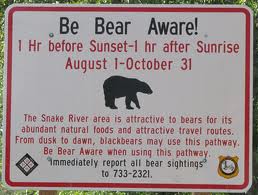 It’s true that, theoretically at least, the human male is far more capable of learning to abide by social rules than a bear is. Regardless, when a sexual assault is imminent, we would do well to ensure that women and girls have every opportunity to learn and employ strategies to ward off assailants—even while we work to find long-term solutions to the problem of sexual assault.
  The Washington Post and others might defend the advice about how to defend yourself against a black bear on the grounds that we must prevent further tragedies and some knowledge can help us do that. They might also say that there is a surprising amount of research on bear attacks—from the differences between grizzly and black bears, bears around cubs versus bears who are alone, and even on whether or not being armed with a gun or bear spray is safer.
Exactly. And we have quite a bit of research on self-defense against the human male as well, and in particular the breed of party and acquaintance rapist found most often on college campuses. Why aren’t we sharing that research with young women in hopes of their warding off, thwarting, and surviving these men’s attacks? We have evidence-based, practical advice for women, but we don’t provide it for them because we fear it will be perceived as victim-blaming. 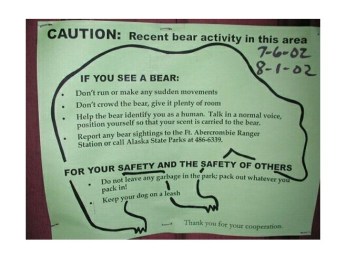 People seem to have no problem telling men and women how to fight off a black bear; nor do we. So let’s also not object to telling women how to fight off your average date, acquaintance, or party rapist. These assailants should be considered unarmed and dangerous, and, as with black bears, there are definite do’s and don’t’s that can be communicated.
  We aren’t going to tell women not to let a man smell food or to keep the dog on a leash (things commonly told to hikers who might encounter a bear). But let’s take the final piece of advice given in the Washington Post and substitute “sexual assailant” for “bear”:
So what do you do if you come face-to-face with a black bear sexual assailant in the wild at a party??
Put up a good fight
Wave your arms, hold up your hands, try to appear as tall as possible. If you’re in a group, stand together. Clap, yell and throw things. “You’re trying to scare it away before it gets too close,” Stiver told ABC News. “Get a big stick, some rocks. Bang pots and pans.” If the bear sexual assailant doesn’t back off and — worst-case scenario — moves in for the attack, “do everything you can to get that animal off you,” Stiver said. Get physical. Punch and kick. “Give it a kick, start swatting the best you can. Stand up tall,” Forbes said. “These sorts of things have been shown to work quite well.”
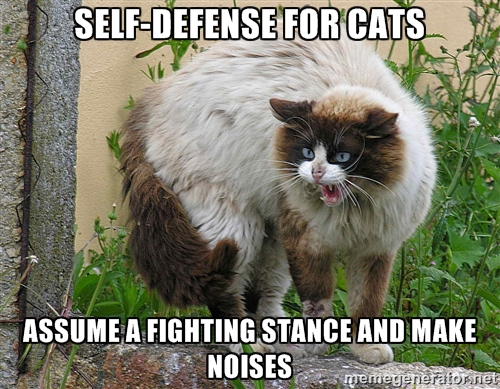
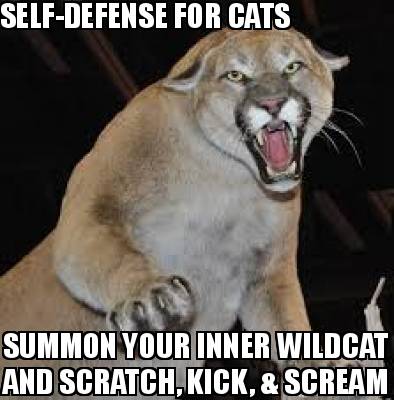
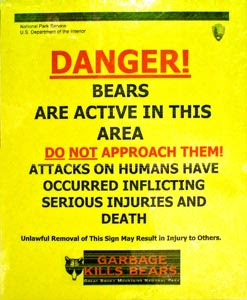
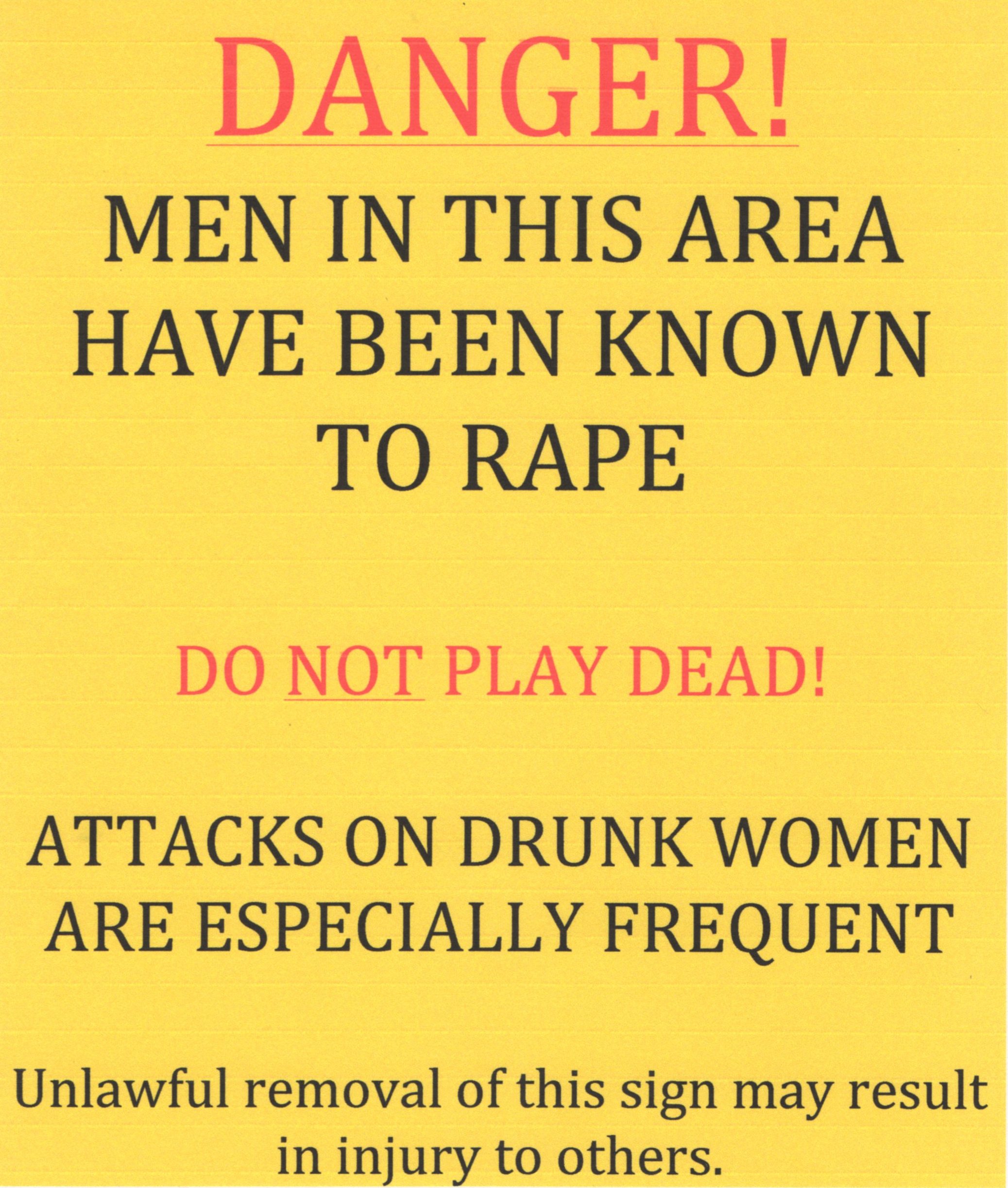
We have no desire to mock the tragic death of the student in New Jersey, or anyone attacked by bears or people. But if it’s socially acceptable to offer strategies for thwarting a bear attack, we can damn well offer strategies for thwarting a sexual assault. We found some great bear warning signs that include how to stay safe and fight back if necessary. So we thought we’d create a few similar signs to advise campus co-eds about sexual assault. 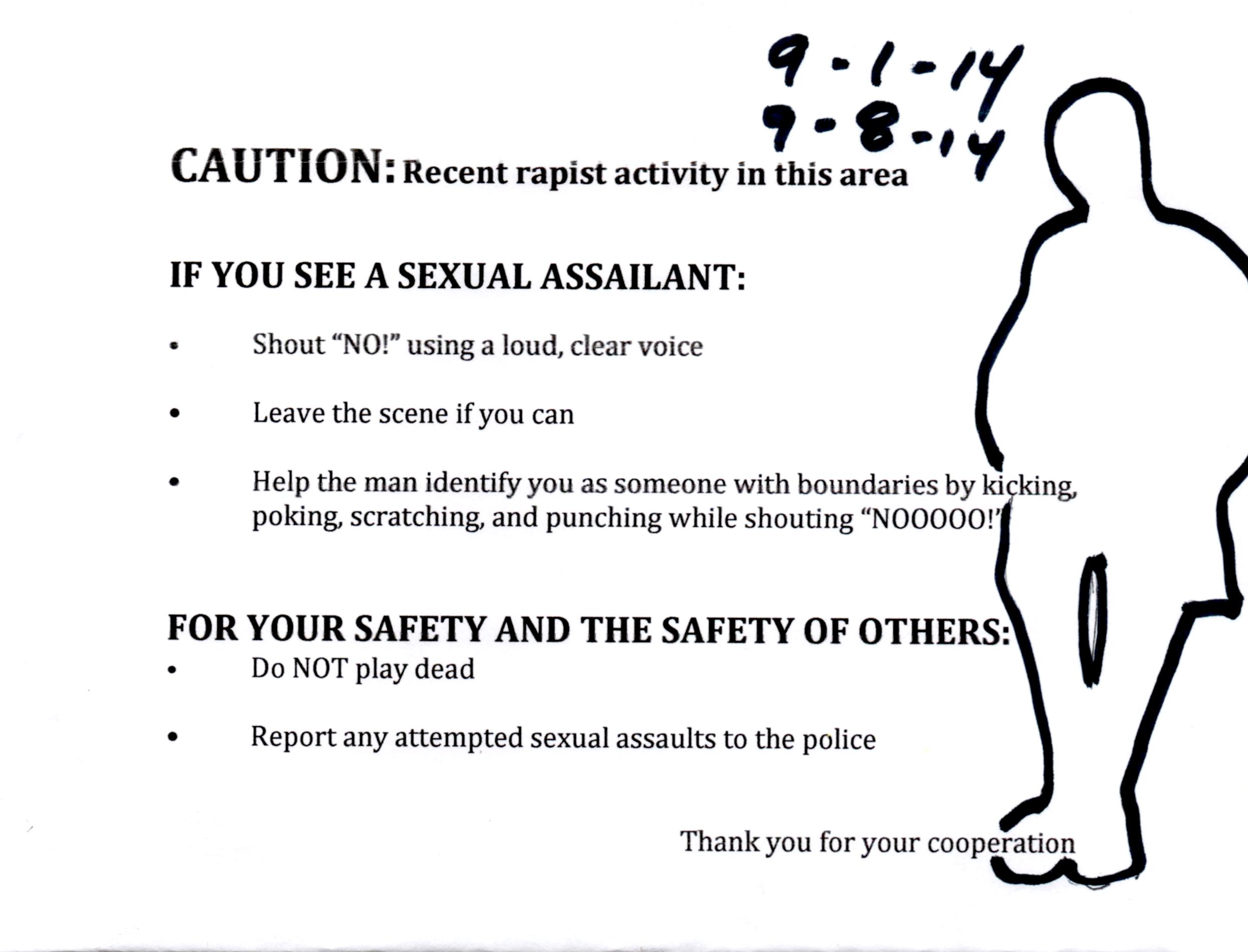

Postscript: A word from one of our readers:
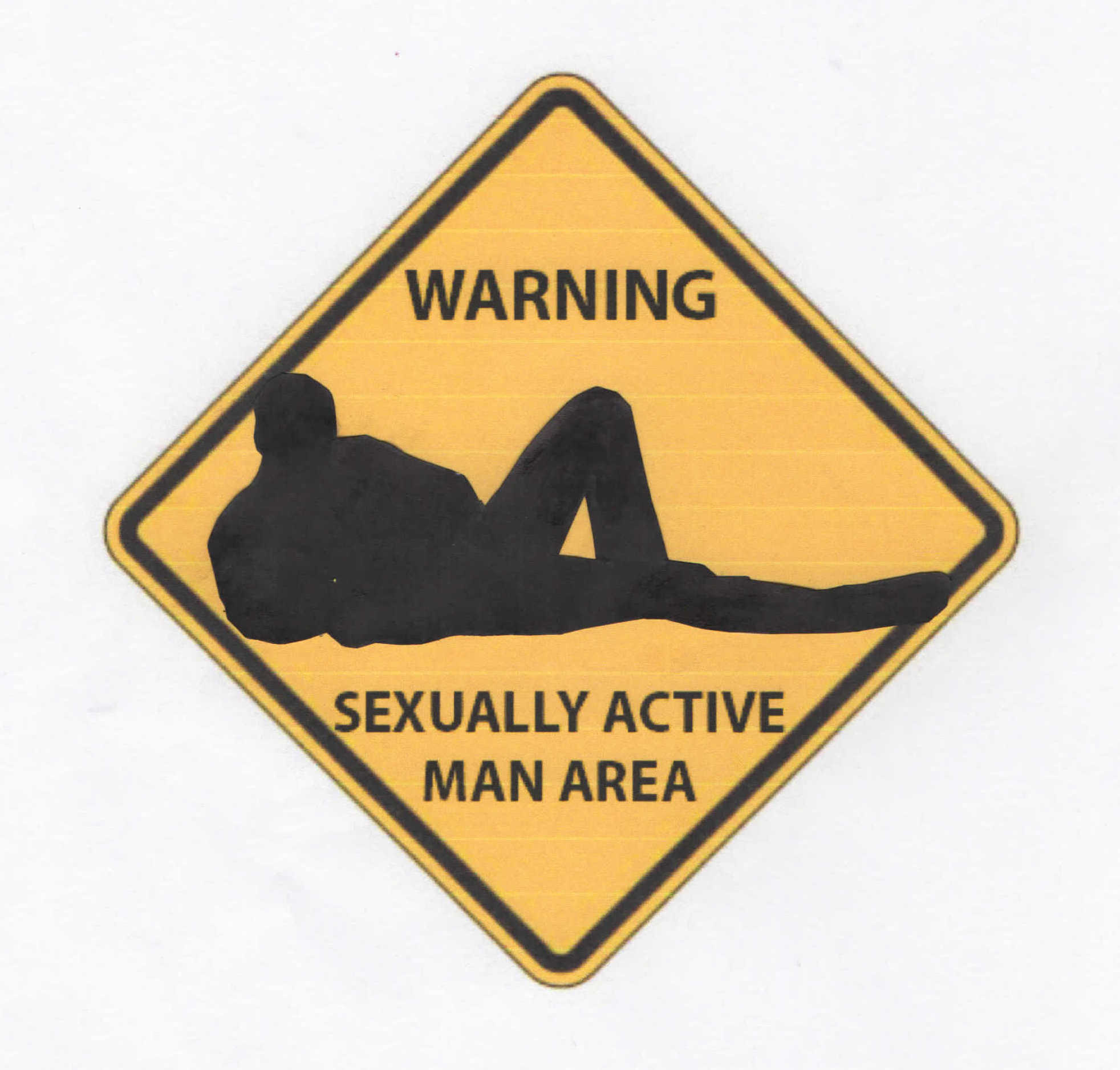
Dear Bloggers, I resent the fact that you created a warning sign with the phrase “Sexually Active Man Area” when, as only some active bears attack, only some sexually active men rape.
Yours,
Etc.
.
An Open Letter to Campus Rape Prevention Training Videos
Dear Campus Rape Prevention Training Videos,
You’re so slick with your semi-pro actors and your use of hip language. We think the companies that made you will really get a lot of mileage out of you. You’ll prove profitable long-term investments now that universities across the country are anxious to comply with federal mandates to offer all incoming students some kind of rape prevention education.
You do a great job explaining what consent looks like. For example, one of you has this whole “can I use your cell phone” analogy. Powerful. I mean, you really get to the heart of the matter when you show the difference between coming up to a guy who’s sleeping and pulling his cell phone out of his pocket versus sitting down next to a guy and asking to use his phone, followed by a back-and-forth about which things on the phone he’s ok with another person playing with. That’s exactly like sexual assault versus affirmative consent.
Also cutting edge are the culture-changing bystander interventions you espouse. Watch how we stop a guy who’s about to go rape a girl. “Uh, Joe, that’s, um, not cool. Let’s get something to eat instead.” We totally get how getting a guy something to eat will fundamentally change the rape culture. And we totally totally agree that committing a felony is “not cool.” Fer sure.
We all want young people to go to school, party, and have sex in an environment that is free from coercion. The problem is, videos, you mostly seem to think that the only way that can happen is if some men step in when other men are coercive and violent, right? Like, “Don’t worry, baby, if someone is trying to rape you; some knight in shining armor will come along and…um…ask the potential rapist if he wants a snack.”
How do you think the women viewing you now feel, as they hope that the cell phone analogy is powerful enough to stop rapists, as they hold their breaths wondering if Joe will, in fact, decide to have a burger or shoot some pool or play beer pong instead of assaulting the woman he’s been targeting all night?
The real question is, videos, what do you have to say when bystanders did not intervene on behalf of the girl? Pretty much nothing, that’s what.
Is there some reason you are so averse to telling a woman what she can do to intervene on her own behalf?
As videos, you could easily show what it looks and sounds like to shout “NOOOOOO!” and “BACK THE FUCK OFF!” and (because not all guys listen in such circumstances) to grab the testicles and twist them, and how a guy typically reacts to that kind of pain. You could show exactly how to land a kick to the groin or head, and how to make a sharp beak with five fingers to poke the eye of one’s assailant.
Oh, feeling squeamish? Imagining the men viewing you now saying “oooooch” and grabbing their crotches protectively? They probably would do that when they watch you. And getting men to imagine THAT might be an effective rape prevention strategy.
Indeed, that would be a whole lot more effective and specific than the clip of the local campus police specialist at the University of Montana who says you can “come and see him in his office to talk about the self-defense courses that he offers.” (Although a step in the right direction, University of Montana video! Now, show us a knee to the groin.)
What do you imagine women would feel and do if they had the opportunity to watch women like themselves respond powerfully and effectively to enforce their bodily boundaries? We’re women and as we watch you we’ve been feeling frustrated that we only see women as damsels in distress.
Campus rape prevention training videos, it’s time to change your tune. By all means, stay slick, stay hip (although know that if you’re actually thinking things like “slick” and “hip”, you might be stuck in 1974) – just get it right.
Sincerely yours,
Martha McCaughey & Jill Cermele
“Clear Communication” Must Include Self-Defense

If you’ve been following the hilarious Tumblr site, “Confused Cats Against Feminism,” you’ll have seen this dog who says “all cats love being chased, you can just tell.” This joke is funny precisely because we know that what the dog believes is wrong, and it mocks the attitude through which a man might dismiss the feminist insistence that women actually have sexual boundaries. If a guy thinks — no, knows — that, deep down, a woman “wants it” and is certain that he “can just tell,” then our rape prevention strategy of telling people to “communicate clearly” is not enough.
Given what a common problem date, acquaintance, and party rape is on college campuses, students are routinely told to “communicate clearly” so that their dates aren’t left to read facial expressions and eye movements. Of course, this presumes that a guy is sexually assaulting out of just “not realizing”, or being insensitive to, the fact that the woman doesn’t want the same thing he wants, and that if he had only known he’d have backed off immediately. While this might be true in some instances, we know this is not necessarily the case, as evidenced by victims’ – and some perpetrators’ – reports that saying “NO” does not always stop an assailant.
Our culture teaches, and therefore some guys learn, that guys’ opinions and ways of defining situations are more important than those of the female persuasion. To take a hypothetical example, if a guy’s buddies (and his men’s magazines, and most TV shows, movies, blogs, and news reports) all convey that when a woman is eating chocolate, she gets so excited that she’ll want sex with whomever is in her company, then this guy will be reading, understanding, and even thinking empathically about this chocolate-consuming woman (or at least his idea of women), as wanting to have sex with him.
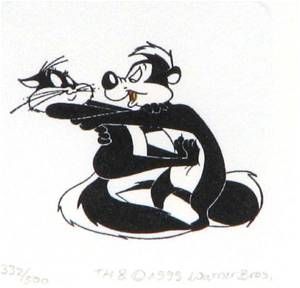
The 1960s Warner Brothers Pepé Le Pew cartoon humorously illustrates this point. In that cartoon, a male skunk chances upon a black female cat who has unfortunately had a stripe of white paint spilled across her back. Since we know she’s a cat, we understand that she finds the skunk repugnant. Pepé Le Pew is comically clueless as he chases the nonverbal kitty and repeatedly attempts to capture her. At every turn, the skunk interprets every act of resistance on the cat’s part as a further invitation to him to pursue her. When she attempts to run away from him, and when she resists him by hitting him over the head, he construes her as “flirting.” He concludes that “she wants to play hard to get” and that “she is shy” at other points when she shows what we know is opposition to him. At one point, the skunk expounds, “She thinks that by running away, she can make herself more attractive to me. How right she is!”
Now, in the world of cartoon skunks, we might assume that a female skunk would indeed desire Pepé le Pew, simply because she too is a skunk, and we recognize that Penelope does not want Pepé because she is really a cat. However, in the world of human beings, as Virginia Tech sociologist Neal King’s analysis reminds us, there is no category through which a guy can assume or presume a woman is sexually interested in him. Yet in a rape culture that constructs women as sexually available to men for the taking, a guy might arrogantly (mis)interpret any number of things – a woman’s race, social class status, college Greek house, academic status, level of attractiveness, gestures, and behaviors – as a desire for sex with him. But none of those things can, or should, provide a guy any assurance whatsoever of his desirability to a woman. Sadly, though, as Prof. King (p. 874) puts it, “[M]en can interpret anything that women do as signs of desire.”
Given the all-too-common tendency of guys interpreting, Pepé le Pew style, women’s behavior as signals of sexual interest, Dr. King concludes that no amount of telling men or women to communicate better will necessarily bring about sexual encounters that are truly respectful and consensual. If the problem is the default assumption, “She wants to have sex with me!”, then telling men and women to communicate more clearly won’t reduce the number of sexual assaults on dates and at parties. King (2003: 874) argues that the rape prevention strategy that emphasizes the victimization of women “may be the least constructive part of our project.” Further, he argues that affirming women’s vulnerability (as opposed to emphasizing their willingness and ability to resist rape) and encouraging men to know women more, and more deeply, are bound to backfire on us.
A good way to challenge men on their sense of certainty is to get them to question how they “know” what they “know” about women, to make them feel less certain than they may already feel.
Furthermore, if we teach women the techniques that allow them to back up their verbal communication with physical resistance, then we do two things: we give them the practical, in-the-moment tools to thwart a sexual assault, and we provide to men a series of behaviors and words far less likely to be (mis)interpreted as sexual interest. Teaching women to defend themselves, publicizing their ability widely, and pressing the point that women resist might just challenge men’s sense of sexual certainty.
Postscript: We regard it as no coincidence that Neal King has cats.
Top Ten Links Jane Loves
Ever feel like putting down the reading and just watching something funny? Well, look no further! Below are links to some of our favorite videos inspired by smart, nuanced, tongue-in-cheek feminist critique. And they say feminists don’t have a sense of humor! (Q: How many feminists does it take to change a light bulb? A: THAT’S NOT FUNNY!).
So get out your popcorn, put your feet up, and enjoy!
- Jane Austen’s Fight Club. Jane Austen fan? Us too! (Less so Mr. Darcy, but we will save that for a future post). What happens when Lizzy and Emma start a fight club?
- “Defined Lines”- Fantastic Music Video Parody of Robin Thicke’s Blurred Lines Music Video by the Law Revue Girls. Robin Thicke fan? Neither are we! But even if you secretly, or not-so-secretly, like his song “Blurred Lines,” we think you’ll like this fantastic feminist version even better (and if you like Weird Al, you’ll see that he’s met his match)!
- “Word Crimes” – Equally, albeit differently, fantastic music video parody of Robin Thicke’s Blurred Lines, by Weird Al. Remember: Just like an assertive bodily comportment, grammar should be stressed until it becomes a habit.
- “The Fault in Our Schools” – courtesy of The Daily Show with Jon Stewart. Yes, we know, we wrote an open letter suggesting they needed to do “Part II”, but Part I was still pretty damn funny.
- Sarah Haskins’s Target Women: Broadview Security. A must watch on the commodification of women’s fear for profit, and laugh-out-loud funny to boot. If you like this one, check out others in her series, ranging from menstruation to skin-care products to Twilight (don’t get us started on Twilight, either).
- “The Oppressed Majority” by Eleonore Pourriat: A Typical Day of Sexual Harassment and Assault, but with the genders reversed.
- Confused Cats Against Feminism – A parody of “Women Against Feminism” that has been called “willfully ignorant” (we wish we were the first to apply that label to that tumblr site, but The Los Angeles Times beat us to it). We love how this satire site harnesses those apolitical “cute cat” memes for feminist political purposes.
- Toddlers and Tiaras with Tom Hanks – All we can say is thank you, Tom Hanks, for this hilarious video about teaching little girls the bodily comportment of femininity. And “Sexy feet! Sexy feet!”
- Stephen Colbert and the Health Nazis – From 2011, and disgustingly, at least as relevant now as it was three years ago. We hear the same thing about teaching self-defense that is said here about birth control.
- The Misandry Make-Up Tutorial – Part of a new witty, culture-jamming style of feminism known as “ironic man-hating,” this video shows you how to apply cosmetics to achieve the perfect look for the matriarchal takeover!
Miss Eliza Leslie’s Hookup Handbook for Ladies
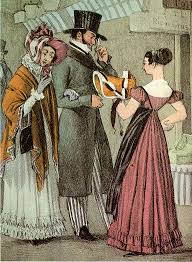
Ladies have both a body and a mind. At times the indiscrete, sweating, aging, and sagging former seems to hold the latter hostage. And yet, on a nice sunny day when one is feeling good, one hardly feels challenged by her embodiment and a lady might find herself seeking the affections of a gentleman. Indeed, the practice of hooking up at parties or at the prompt of a text message is now universal.
A lady must therefore know how to proceed when under the sweet liberty of the primal pleasures of the body, especially because not all gentlemen will comport themselves with the propriety a well-mannered deportment demands.
Indeed, some gentlemen will make impertinent carnal requests—nay, demands—insisting that they are subject to an infirmity of the sort that prevents them from having a rational command over their bodies. A lady need not bear this malady on his behalf. For this man, regardless of fame or fortune or position on the football team, is a blockhead and you may simply explain that you will not engage in this behavior and expect him to stop. Indeed, a lady ought to shout “STOP” as loudly as she likes to emphasize that her desire had been a product of his illusions.
However, ladies should note that only some gentlemen will atone for their offense at this point, while others will stubbornly persist in their attempt for carnal knowledge of her.
When in the company of such affronting men the usual rules of propriety and feminine manners must be dropped and a lady should not hesitate to visit on the gentleman a violent change of fortune.
For example, a lady should know that the testicles of the gentleman (and it should be noted that once the aforementioned gentleman has proceeded beyond a “stop”, we are using the word “gentleman” with a deliberate sense of irony) house a significant number of sensory nerve endings, and lack the protection of bone, muscle, and fat. Therefore, a lady should know that a squeeze, twist, pull or slap to this area of the body, which the Creator has so conveniently located outside the body, effectively communicates the “STOP” which the gentleman may have had the arrogance or entitlement to ignore. In fact, it seems likely that their location outside of the body is designed to serve just this purpose – the conveniently located reminder – nay, warning – to gentlemen that “STOP” means “STOP”, and that “NO” means “NO”. Therefore, far from needing to worry about importuning this gentleman, a lady demonstrates her reverence for herself when she engages in this vehement, but necessary, rebuff.
Upon such action, the gentleman in question will likely drop to his knees; tears are likely to form in his eyes, and his skin may change in color in alarming ways. The gentleman may even find himself unable to move for some time without regurgitating the contents of his stomach. A lady need not concern herself with any of these responses, nor should she remain in the situation to observe or assess the situation at hand. A lady has better things to do than to dally with gentlemen of this ilk, and should ring 9-1-1 straight away.
By Martha McCaughey and Jill Cermele, inspired the 1853 “The Ladies’ Guide to True Politeness and Perfect Manners, or Miss Leslie’s Behavior Book, An Excerpt” by Eliza Leslie (author of “Mr. and Mrs. Woodbridge”), published in Selections from Eliza Leslie, edited by Etta M. Madden, Lincoln: University of Nebraska Press, 2011.
An Open Letter to NYT Op Ed Columnist Ross Douthat
Dear Ross Douthat:
Your New York Times Op Ed piece on June 28, 2014 offers three ways American colleges could get to the root of the problem of campus sexual assault, thereby having fewer sexual assaults going through the often criticized campus judiciary process that was originally meant to handle minor infractions.
We share your desire to make sexual assault harder to accomplish rather than service victims’ post-abuse lives (what you call “after-the-fact responses”).
We also share your skepticism that our society will lower the drinking age (the first of your three solutions), or that universities will weaken the college party scene (solution #2). Your third solution is to go back to a gender-neutral version of the old sex-segregated, chaperoned campus.
Of course sex segregation, curfews, and less unsupervised partying would technically give men less opportunity to rape—but only because it would give them less opportunity to hook up with women (in consensual encounters or otherwise). We therefore suggest a different way to stop rape on campus: teach women self-defense. Let’s embrace women’s ability to say yes and to say no and mean it–and enforce it if necessary. Part of self-defense training can be about alcohol consumption. Part of it can be about how to shout “no” forcefully, and how to back up that verbal self-defense with physical self-defense when necessary.
Mr. Douthat, we agree with you that society is not helpless to stop sexual assault. But neither are women.
Sincerely,
Martha McCaughey and Jill Cermele
 See Jane Fight Back

Recent Comments