Wonder Woman – did you hear…?

Dear Wonder Woman,
In light of the recent news story, and given that we do not know the degree to which you are tapped into the media buzz (although we did see you on Facebook), we are reaching out to you. Did you know there is a story in the news that your image has been banned at one elementary school (name and location are being withheld to protect the ridiculous); this in response to a young girl who brought in a Wonder Woman lunch box, which was considered to depict, and we quote, a ”violent image”, because as a super hero, you, and we quote again, “solve problems using violence”.
Care to comment?
The Janes
Dear Janes,
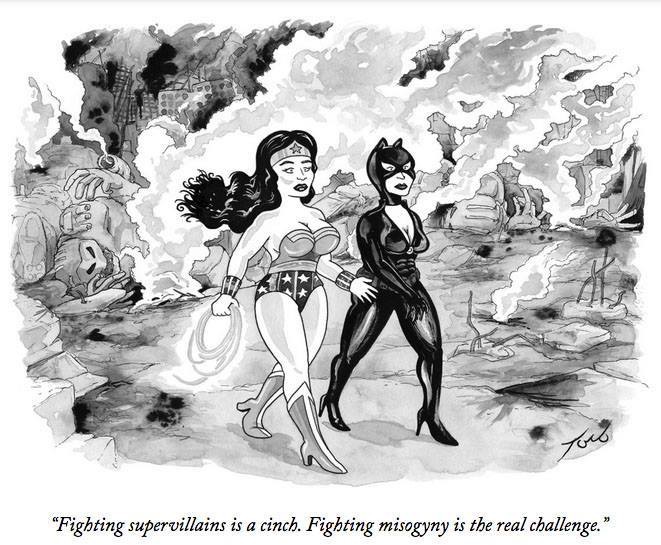
WTF? Don’t quote me on that – as it’s probably “too violent”. But seriously, WTF? I’m a superhero. I fight evil – and, I might add, I do a damn good job of it. How am I supposed to do that, with smiles and unicorns? With polite requests for changes in behavior? How’s this: “That’s just not nice. Please, please, stop your evil ways?” Should I shed a few tears while I’m at it? That’s not fighting evil – that’s offering a label, begging for change, and then hoping for the best. No way. Being a female superhero is hard enough without having to deal with this.
WW, a.k.a. Dub-Dub
Dub-Dub,
We feel your pain. And definitely don’t beg – the data tell us that strategies like that are not effective in resisting violence. We, like you, are tired of people saying that active resistance is bad, and particularly, bad when women do it. We think you’re a role model – we want more, not fewer, girls and women to follow your example, and know that they have the right to resist. Buying your lunch box right now on Amazon.
The Janes
On that note, Janes, what problems do they think I’m “solving” with violence? Disagreements on what to have for dinner? Not getting the job I wanted? Algebra? When we frame evil-doers intent on world domination as a just any “problem to be solved”, it’s no wonder that everyone gets confused. I match my tactics to the situation at hand. Read my bio – sure, I can fight, and I do when I need to, and I’m not apologizing for that. But that would only be my first strategy if I was physically threatened and that response was appropriate. Duh. I’m wicked smart, and I’ve got excellent verbal skills – both of which are incredibly useful in, as that school system might say, “solving problems”. As for weapons, I’ve got a lasso of truth and bracelets that deflect bullets. If that’s solving a problem with violence, guilty as charged.
WW
PS. Besides, are my boys Batman, Spiderman, Iron Man, Superman, the Hulk, and Captain America being banned as too violent? Not that I am suggesting they should be. More likely, not only are they not being banned, they are probably making more money than I am.
What You Really Need to Know About the Freshman 15
As September approaches, young people gearing up for college are inundated with information about freshman year – what NOT to buy for your college dorm room, tips for getting along with your new roomie, how to/why you’ll love freshman year, how to drink at college parties, and of course, the Freshman 15.
Now, all the data tells us that the Freshman 15 is a myth – the average weight gain for students is around 3 lbs (the same as for non-students of the same age), but the problem of sexual assault is not a myth. So we here at SJFB are shamelessly co-opting the phrase “Freshman 15” to give you the top 15 things you actually need to know as college students, first year and otherwise:
- You get to decide what you do with your own body. That’s right – whether it’s what you eat or who you’re with and what you do, that choice is yours, and yours alone, as long as you’re not deciding something for someone else’s body in the process.
- Trust your gut. Take the time to learn how you feel, and pay attention to it. If something, or someone, doesn’t feel right, it’s probably not, and you get to leave any situation or person that doesn’t feel right for you. As they say, there are plenty of fish in the sea (or…carrots in the field, for the vegetarian/vegan crowd…)
- See the options around you. Good advice for anywhere on campus, not just the cafeteria. Take the time to survey who and what is around you, and if something – or someone – isn’t working for you, know that you can choose a different option, whether that is where to live, where to socialize, or who you are spending time with.
- Get the facts. Even in college, and even about sexual assault, misinformation abounds. Don’t rely on what’s right in front of you – whether in conversation with friends, a statement by a professor, or a sign on the door in the bathroom stall. Fact: fighting back can be extremely effective in thwarting an assault – it’s a right you have, and a choice you can make if it feels right to you.
- Tweak your lifestyle. – For the better! Make choices (not just food!) that are good for you, and surround yourself with people who are interested in what you want for yourself, not just what they want from you.
- Swap your go-to order. Old habits die hard, and we often go with what feels familiar, rather than what feels safe and healthy. If what you’ve done before doesn’t feel good now, try something new.
- Skip the stupid aisle. Okay, in the diet magazines, they will you to “skip the salty aisle”, but we like this better. College – like life – is too short to waste with stupid people, and by that, we mean people who are interested in bringing you down to their level. Trust us – there are better aisles out there.
- Do a purge. One nice thing about college is that you get to leave high school (and middle school) behind you. We’ve all made mistakes in the past, and we will make them in the future. Don’t let them define you – a figurative purge allows you to let those go, and move forward in the direction you want.
- Healthy up your happy hour. As we’ve said before, alcohol is complicated. The connection between alcohol and assault on college campuses is well-documented, which in no way means that drinking or being intoxicated makes a person assault someone else, or makes a person responsible if someone assaults them. Know, whether or not you choose to drink, that it is important to know your limits and the risks associated with alcohol use.
- Pile on the boundaries. You get to “no” to things you don’t want, without disclaimer, explanation, or apology. As scholars who write for a living, we are here to remind you that “No” is a complete sentence. (And remember – what’s posted on-line STAYS on-line. Err on the side of caution.)
- Show some restraint when appropriate. Whether in person or on social media, remember that you are not obligated to please others at the expense of your own happiness and well-being.
- Get off the couch. Staying physically active in college is a great way to manage stress and manage your moods. Stay focused on exercise that makes you feel better—not whether it makes you look better.
- Know what you stand for. Notice injustice and oppression in your environment – your own personal space, and the world at large – and decide how you can respond to it safely. Being in college is just like being in any other community: there will be conflicts, tragedies, and triumphs. And what kind of community member you choose to be will help shape what that community becomes. Part of a group or club doing something deplorable? Take a stand—change it, report it, leave it.
- It’s always okay to ask for help. Whether it’s help with your writing skills, with depression or anxiety, or in a situation that feels unsafe, ask for what you need. You may be living on your own, but you’re not an island. College campuses have more resources than ever to support your well-being and your academic success. Know the resources out there, and don’t be afraid to use them.
- Get fired up. Take the time to get to know yourself, and then go for it, full steam ahead. Know what you want – and don’t want – and keep your eye on the prize. You’re in college to be an academic rock star and pursue your dreams. College is about making your future, so evaluate every option or course of action based on whether it will help, or hinder, achieving your goals. Believe in yourself. We believe in you.
It’s time for another lesson from the University of the Bleeding Obvious.
Back when Miss USA, Nia Sanchez (we love you, Nia, even if you won’t return our phone calls), said that to combat the problem of sexual assault on college campuses more women should be offered the opportunity of self-defense training, feminist-identified pundits with access to HuffPo interviews flipped out. The concerns varied: some said that recommending self-defense training is putting the onus on women (rather than men) to prevent rape; others argue that self-defense training wouldn’t work because the likely perpetrator is someone known to the victim, and that’s not the “mind-set” for self-defense.
But the real head scratchers were those who rejected self-defense training on the grounds that it ran counter to feminine socialization. They understood that the fact girls and women are trained to subordinate their interests to boys and men, and that this feminine socialization interferes with defending themselves. Indeed, self-defense training is all about NOT subordinating your interests to men and boys. So opposing the recommendation to offer women self-defense training on these grounds (http://www.huffingtonpost.com/2014/06/11/miss-usa-self-defense_n_5482117.html) seems to presume that we self-defense teachers and advocates do not understand this. What do they think, that self-defense teachers just show women a punching bag, offer them some chewing tobacco, and say “have at it”?
Let’s offer those most likely to be targeted for sexual assault the skills to intervene on their own behalf. Yes, for many of these people, and women in particular, such skills will contradict their socialization into femininity. Self-defense training is a kinesthetic experience that rattles the feminine training so tragically well suited to rape culture. That’s exactly what we like about it and why it’s so transformative beyond the individual women it helps.
College Rape Prevention Program a “Rare” Success? An Open Letter to Jan Hoffman at the NY Times
Dear Ms. Hoffman,
In “College Rape Prevention Program Proves a Rare Success”, you concluded an otherwise empowering, data-driven piece on the effectiveness of self-defense by trotting out a quote from Kathleen Basile at the CDC, who ignores the data in suggesting that self-defense training places the “onus for prevention on potential victims”. Self-defense is a key protective factor in rape prevention, as Senn’s data clearly demonstrate; no disclaimer required. It is no more problematic to suggest women have the option of self-defense training than it is to suggest that women do a self-exam for breast cancer or wear sunscreen when they go outside. The only difference is that we are far less comfortable with the idea of women’s use of defensive violence than we are with other, kinder, and gentler ways that we support women’s self-care.
The responsibility for rape lies with the perpetrators; suggesting that self-defense somehow shifts that responsibility to the victim is what is misguided and victim-blaming, not the option of self-defense for women.
PROTECTING YOUR HOME – BUT AT WHAT COST? THE TOP 6 REASONS NOT TO GET A HOME ALARM SYSTEM
We at SJFB are getting a little tired of the latest backlash against self-defense, and the knee-jerk responses, by feminists and non-feminists alike, to Dr. Charlene Senn’s study out of the University of Windsor on the effectiveness of self-defense training in reducing the likelihood of attempted and completed assaults against college women, which was published in the New England Journal of Medicine.
It’s easy to dismiss self-defense training and women’s capacity or powerful, effective resistance: it rocks the status quo in a way that other responses to rape and sexual assault, like marches and t-shirts and performance art, just don’t. But the responses reflect our cultural discomfort with women’s empowerment and entitlement to self-defense far more than any logic or data.
Not convinced? Change the topic to home alarm systems – an option that some people choose as a way to minimize or thwart burglaries or home invasions.
- IF A WOMAN HAS TO GET A HOME ALARM SYSTEM, THAT WILL ONLY MAKE HER FEEL FEARFUL, SMALL, UNSAFE, AND SELF-RESTRICTING IN HER OWN HOME.
- IT MIGHT NOT WORK (AND IF IT DOESN’T WORK, IT WILL RESULT IN BLAMING HER FOR NOT HAVING GOTTEN ONE THAT WAS MORE EFFECTIVE.)
- SHE MIGHT FORGET TO TURN IT ON, AND THEN IT WILL BE HER FAULT IF SOMEONE BREAKS INTO HER HOME
- IF SHE HAS A HOME ALARM SYSTEM AND HER NEIGHBOR DOESN’T, THEN AN INTRUDER MIGHT JUST LEAVE HER HOME AND MOVE ON TO HER MORE VULNERABLE NEIGHBORS, AND THEN IT WILL BE HER FAULT IF SOMEONE BREAKS INTO THEIR HOMES.
- NOT EVERYONE HAS THE OPPORTUNITY TO GET A HOME ALARM SYSTEM, AND SO WHAT ABOUT THOSE PEOPLE?
- GETTING A HOME ALARM SYSTEM IS AN INDIVIDUAL SOLUTION TO THE SOCIAL PROBLEM OF CRIME AND UNFAIRLY PLACES THE ONUS FOR CRIME PREVENTION ON THE HOME OWNER
Ridiculous, right? No one has to or can get a home security system, but we don’t challenge anyone’s right to get one, and we don’t worry about victim-blaming, or the (undocumented, unsupported-by-the-data) fear of putting others at risk by choosing to get one. And we certainly don’t suggest people don’t get one because it’s not the end-all, be-all solution to crime.
Sure, our bodies are quite not property that we live in and need to protect from robbers. But the analogy works to show how flimsy the knee-jerk reactions to Senn’s self-defense study are.
Instead, let’s celebrate this data – that self-defense training for college women can effectively reduce their risk of assault – and put that in the context of all the other data on the efficacy of self-defense in thwarting rape. Let’s put our energy instead into demanding that organizations, educational institutions, and governments make funding available so women and girls have the option, not the onus, of self-defense training. That’s the cost to focus on, because we know the cost of violence against women. Last year, the CDC had a budget for sexual assault prevention of about $50 million dollars. That could fund a heck of a lot of self-defense classes.
The Golden Rules of Womanhood
Sociologist and well known masculinity scholar Michael Kimmel describes the four golden rules of manhood as:
- No sissy stuff
- Be a big wheel
- Be a sturdy oak
- Give em’ hell
We love critiques of masculinity, but we at Chez Jane tackle social constructions of femininity. Taking off from Kimmel’s golden rules, we therefore offer you the four golden (softened with 4% silver and 21% copper to a flattering rose hue) rules of womanhood. Take note, sisters:
- Take the back seat*
- Be a willow (weeping if appropriate, but soft and supple)**
- Contain the fury***
- Look pretty****
Of course, we could argue, as Michael Kimmel does, that these rules are the socially constructed products of a patriarchal, heterosexist rape culture, and that deconstructing socially prescribed masculinity and femininity would do wonders in shifting the ways in which individual, social, and structural rules about gender perpetuate the rape culture, not to mention do wonders in improving the quality of life for everyone, regardless of gender. But doing so would violate at least rules #1-#3, and probably #4, as well.
Dammit. (Oops – contain the fury. Contain the fury!)
________________________________________________________________________________
*Big wheels are for the boys, ladies. We know; we checked Google images. Unless they’re pink. But still.
**Everyone can’t hold their ground, you know. If manhood is about being strong, unflinching and unbending, someone’s got to yield, right?
***Because fury, however justified, is neither pretty nor hot. Reference rule #4.
****Or hot, depending on the situation and the requirements of your husband/boyfriend. But not too hot. Because that’s slutty. Unless he wants you to look really hot. But only for him. (Not sure how to negotiate that one – good luck.)
Joe, please read this email —
Dear Vice-President Biden,
Forgive us for calling you Joe, but when you sent Martha this email, you used her first name, and it was such a nice, personal touch, we thought you wouldn’t mind. We did read your email, and we found it compelling and clear, in intent and request. So we’re sending you one back (okay, this isn’t exactly an email, but you get the idea), and we borrowed the format (yours is on the left, and ours is on the right). We hope you don’t mind.
We read your email, Joe. Please, read ours:
| Martha — What do you want out of the next two years?Me? I want to finish President Obama’s second term strong and elect Democratic leaders who will champion priorities like increasing the minimum wage and strengthening Social Security.Barack and I are committed to advancing these priorities. But if we as Democrats don’t start working right now to make it happen, we’re in for a much bleaker future. One in which the Republicans in power serve only the ultra-wealthy, ignore the reality of climate change, and turn Medicare and Social Security into something unrecognizable.
Whether we can achieve success depends on what you do, right now. Will you help us fight for Democratic values and elect the progressive champions oftomorrow? Pitch in to the DSCC’s Back to Blue campaign by the FEC deadline in 96 hours. If you’ve saved your payment information with ActBlue Express, your donation will go through immediately: There’s a choice to be made: We can have strong Democratic leaders who fight for a progressive agenda — or a Republican president like Jeb Bush or Ted Cruz, with a GOP Senate that rubber-stamps each reckless decision. What’ll it be? Your actions right now will determine the outcome. Thank you, |
Joe – What do you want out of the next two years? [or actually, forever?] Me? I want all girls and women to have the opportunity to be trained in self-defense, by instructors who will remind them that they have the right to defend themselves and teach them how to do it. Self-defense advocates and scholars world-wide are committed to advancing these goals. But if we as concerned citizens don’t start working right now to make it happen, we’re in for a much bleaker future. One in which those who benefit from the rape culture will continue to perpetrate violence, and rob them of their basic human rights. Whether we can achieve success depends on what you do, right now. Will you help us fight for equal rights for women and girls by supporting self-defense training? Pitch in to start by including self-defense training in the recommendations of the White House Task Force on Sexual Assault on College Campuses. [Okay, here, you ask for donations. If you are interested in donating money in support of women’s and girls’ self-defense training, we will happily direct you to a number of excellent organizations.] There’s a choice to be made: We can empower girls and women, remind them they have selves worth fighting for and give them the skills and tools they need so self-defense is an option when they are faced with rape and sexual assault – or we can continue, however inadvertently, to perpetuate the rape culture that says that women and girls are there for men’s taking, that men and not women are the ones with power. What’ll it be? Your actions right now can help determine the outcome. Want to make sure that women and girls have the same rights as men and boys to? Then offer women the same rights to securing their own safety that you have suggested in other interviews that men should enforce for women – the right to “kick the living crap” out of someone who is trying to rape them. Because you’re right, Vice President Biden. It’s on all of us. Thank you, |
An Open Letter to the BBC News Magazine, Regarding the Article Entitled “New Dehli Rapist Says Victim Shouldn’t Have Fought Back”.
Dear BBC News Magazine,
On March 2, 2015, you published an article covering an interview with one of the rapists/murders of the young Indian woman who was raped on a bus in New Dehli in 2012, and who died as a result of fatal internal injuries these rapists perpetrated against her. It is a terrific article about misogyny and rape culture, about gender inequality and those with the courage to speak out and fight against it, and the vicarious trauma many of us experience when we listen and give voice to these stories. The story is situated in Indian culture, but we are hard-pressed to think of a society and culture today where this could not happen, where these views and this violence against women and girls are not present.
That’s what your article is about, and we’re glad we read beyond the title. Because your title is not a statement about deep-seated culture acceptance of violence against women and girls. Instead, it is a warning to women and girls everywhere: Don’t Fight Back. Or Else.
The fact that this young woman died because she was killed by rapists/murders is a travesty to which words cannot do justice. The rapist/murderer who was interviewed justifies his violence against her the way so, so many others do – by blaming the victim. It is her fault, he says, that he and his companions raped her, because she was there. It is her fault, he says, that he and his companions murdered her, because she fought back.
Memory is reconstructive, and self-serving, and of course a rapist/murderer will seek to justify his own actions by saying that his victim made him do it. That does not make that true, nor does it mean that women and girls who fight back against sexual violence are inviting murder, are making those perpetrating the violence against them step it up a notch. In fact, research has demonstrated that there are no statistically significant difference in injury rates between women who fight back and women who don’t. That means that some women who choose to fight back against a sexual assault will sustain additional injuries beyond the sexual violence, just as some women who choose not to fight back, or who are unable to fight back, against a sexual assault will also sustain additional injuries.
You published an important article, but your choice of title, by quoting the rapist rather than accurately framing the real content of your piece, contributed to misogyny and rape culture, rather than taking a stance against it. He did say that, according to the description of the interview. That doesn’t make it true.
An article of this caliber deserves a title that matches it. Try any of these:
Rapist Rationalizes his Murder by Blaming the Victim
Rapists Continue to Blame Their Victims for Assault
Victim-Blame is a Global Problem
New Dehli Murderer Tries to Weasel Out of Death Penalty by Blaming the Victim
Rape Culture Thrives at the Expense of Women’s and Girls’ Lives
Please, don’t retract your article, but do retract your title. Your article, and women and girls everywhere, deserve better.
Sincerely,
Jill Cermele and Martha McCaughey
An Open Letter to the Myriad Anti-Rape Devices Marketed Toward Women That Is So Not Going to Go Viral:
Dear Anti-Rape Devices Marketed to Women,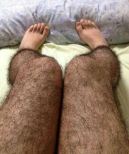
We don’t mean to be impersonal, Anti-Rape Devices (ARDs). But there are just so many of you, we don’t want to leave anyone out. Where to start? The Anti-Rape Gloves? The Anti-Rape Underwear? Rape-aXe, the Anti-Rape Condom? Hairy Legs Tights? (Because everyone knows, only women with smooth legs get raped.) I know there are others of you out there, but it’s like the Golden Globes: if we try to mention all of you, the music will start playing, and we’ll never get to finish. So please know, this is for all of you.
We know you mean well – you don’t women to get raped, and we don’t either. But as fashion-forward and entertaining as many of you are (what shade of Anti-Rape Nail Polish will go best with my Anti-Molestation Jacket that can deliver 110 volts of electric shock to the asshole trying to feel me up?), we must point out that you are missing a critical point, as you drape, adorn, and hide the bodies of the women you intend to protect: those bodies themselves, the actual bodies of girls and women, can be powerful tools of resistance. And when you don’t say that, you contribute to the cultural discourse that says women and girls HAVE to have these things, because if they don’t, there is NOTHING THEY CAN DO to stop a rape or an assault from occurring.
Not true, ARDs. Not true.
Your goal is the same as ours, ARDs. We want men, and others, to stop raping, and we don’t want anyone to ever be raped or assaulted ever again, ever. Here is where it seems we disagree: we know that women and girls are capable of fighting back against sexual assault, and we know that training women and girls in self-defense techniques reminds them of that, and teaches them how to do that.
But for many people, ARDs, you seem so much easier, so much more logical, so much more realistic, so much prettier. Because many, many, MANY people don’t believe that women and girls are capable of thwarting an attack. Here’s the good news – they are! Women and girls can defend themselves, and they do. But that’s not as catchy a headline as “Will Jagged Teeth Deter World Cup Sexual Assaults?” or “Japanese Anti-Rape/Anti-Mugging Dress Transforms Into Vending Machine Disguise”. 
We don’t know how to make self-defense and self-defense training “catchy”. Listen, if Miss USA gets slammed for even suggesting it should be an option, we know we’ve got an uphill battle. But here’s what we do know:
- Responsibility for rape always lies with the perpetrator
- Women and girls can effectively fight back and thwart rape and sexual assault (data! There’s data!)
- Self-defense and resistance, broadly defined, are options we want women and girls to have at their disposal, not requirements that make women and girls responsible for the violence perpetrated against them
- ARDs can be options available to women, but they should be real options that increase women’s and girls’ safety, not the just the Next Cool/Hip/Fun/Pink Thing that perpetuates one of the underlying tenets of rape culture: that women are weak, helpless, and inherently rapeable unless men or products are available to save the day.
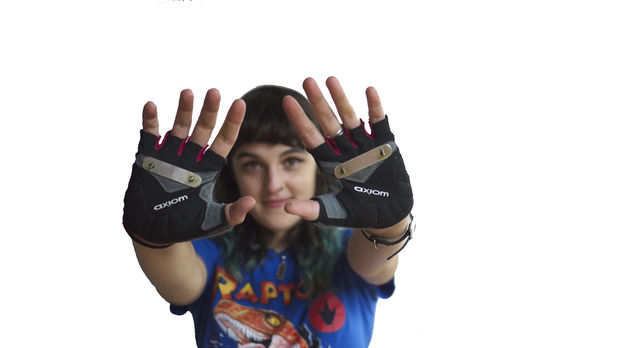
We’ll make a deal with you, ARDs. You stop making promises about safety that have no data behind them, and stop perpetuating the myths that say women are incapable of resistance, and start promoting women’s and girls’ rights to and capacity for self-defense, and we’ll follow the 15-step instructions for the Anti-Rape Gloves (Step 1: 2 pieces of marine grade stainless 12mm wide (half inch) 120mm long (about 5 inch) 2mm Thick (5/64 inch)? Check!) and post a picture of how it turns out on BuzzFeed: Nailed It, for sure.
XOXO –
Jill Cermele and Martha McCaughey
P.S. By the way, how DO you go to the bathroom while wearing the anti-rape underwear? Maturing women want – nay, NEED – to know.
 See Jane Fight Back
Recent Comments